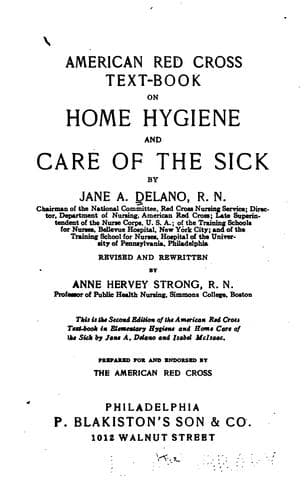
American Red Cross Text-Book on Home Hygiene and Care of the SickAmerican National Red Cross
Science
American Red Cross Text-Book on Home Hygiene and Care of the Sick
American National Red Cross
Home nursing; Hygiene; Nurses; Nursing
The taste of castor oil is so disgusting that it often causes vomiting,
but if skillfully given the oil need not be tasted by a patient who is
willing to coöperate. Its way of sticking to the tongue and teeth
constitutes the chief difficulty; the object therefore is to prevent it
from sticking by swallowing the dose all at once. To administer the oil,
wet the inside of a medicine glass or large spoon with very cold water,
and leave a little water in the bottom. Pour the required dose in slowly
and cover it with more cold water. Let the patient hold in his hand
something to take away the taste,--cracker, bread, peppermint, or
whatever is allowed; for castor oil water is not very effectual. Then
direct him to hold his nose, open his mouth, and hold his breath;
caution him to let the oil run down without swallowing until all has
been taken, and afterward to chew the cracker, continuing to hold his
nose until he has swallowed the cracker. When the patient understands
and is ready, pour the dose in quickly as far back as possible, taking
care not to spill the last drop on the lips. This process may seem
unduly troublesome, but when castor oil is needed it is badly needed and
efforts to make it stay down are worth while. The following method also
effectually disguises the taste of castor oil: place in a glass a
teaspoonful of baking soda, add the prescribed dose of oil and then the
juice of half a lemon. Mix all together thoroughly and let the patient
take the mixture while it is effervescing. This method may be used
unless the patient is not allowed soda and lemon juice. Castor oil may
be bought in capsules, but on account of their size many people find the
capsules impossible to swallow.
SUPPOSITORIES.--Sometimes medicines are given through the rectum. For
this purpose they are combined with cocoa butter or other material, and
made into small cones called suppositories. They melt at a low
temperature and should be kept on ice until needed. A suppository
should be lubricated with vaseline, and inserted very gently as far as
the finger can be introduced, while the patient is lying on the back or
left side.
ENEMATA.--An injection of a fluid into the rectum is called an enema.
(Plural, enemas, or enemata.) Enemas are generally used to cause
evacuation of the bowels.
For a simple purgative enema one of the following is generally used:
plain water; or a solution of common salt in the proportion of one
teaspoonful of salt to one pint of water; or soap suds made with a white
soap such as castile or ivory. Unless otherwise ordered the temperature
of the enema should be between 105° and 110° F.
Public-domain text, read in full here on John Shaqi.
Reviews
Reviews
No reviews yet
Be the first to share your thoughts on this work.
Elsewhere in the archive
Join the Discussion
Join the discussion
Sign in to leave a comment or review.
Sign InorCreate an account