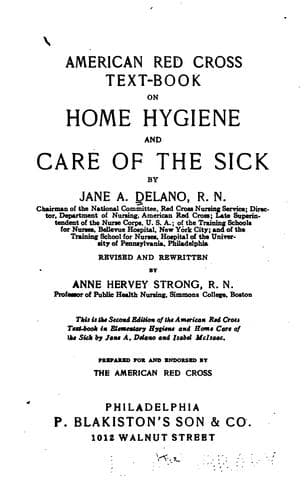
American Red Cross Text-Book on Home Hygiene and Care of the SickAmerican National Red Cross
Science
American Red Cross Text-Book on Home Hygiene and Care of the Sick
American National Red Cross
Home nursing; Hygiene; Nurses; Nursing
Specific directions for disinfecting in every kind of communicable
disease would be too extended to be given here. In each case the
attendant should learn from the doctor just how that particular disease
is communicated, just what discharges, utensils, linen, etc., need to be
disinfected, and just what disinfectants he prefers to have used. The
following general methods are now in use, but it must be remembered that
from time to time new methods are devised and new disinfectants are
discovered.
CARE OF NOSE AND THROAT DISCHARGES.--The care of handkerchiefs has
already been described on page 239. Cloths or cotton used to wipe the
eyes or to receive any other bodily discharge including vomitus, should
be collected in the same way and burned. Everyone should be taught in
early childhood to cover the nose and mouth with a handkerchief during
coughing and sneezing; if the patient has not already learned to do so
he must be taught now. If the amount of expectoration is great,
waterproof receptacles should be provided, which should be burned with
their contents.
CARE OF DISCHARGES FROM THE BOWELS AND BLADDER.--At the present time the
following preparations are commonly used to disinfect stools and urine:
5% solution of carbolic acid; chloride of lime solution, made freshly
whenever needed by mixing thoroughly ½ pound of chloride of lime with
one gallon of water; and unslaked lime to which is added _hot_ water.
The amount of carbolic solution used should be about equal in bulk to
the amount of material to be disinfected; the chloride of lime solution
should be at least twice, and the unslaked lime at least one-eighth the
bulk. Fecal masses should be broken up so that the disinfectant may
reach every part; they may be stirred with tightly twisted toilet paper,
which should be left in the bedpan and disinfected with the stools. If
these substances are used, disinfection is considered complete at the
end of an hour, and the contents of the bedpan may then be emptied into
the toilet with safety. It may be necessary to provide two bedpans so
that one may be available for use while the contents of the other is
being disinfected. Bedpans and urinals should be boiled daily and kept
thoroughly clean at all times.
In places having no sewerage system, disinfected discharges may be
emptied into a trench situated at a distance from the well, and then
covered with earth. As an extra precaution, the disinfected discharges
may be mixed with sawdust or kerosene and burned in the trench.
Directions for installing a sanitary privy may be found in Bulletin 68
of the United States Public Health Service.
BATH WATER and water that has been used for cleansing the teeth and
mouth may be disinfected in the same way as urine, or it may be emptied
into a suitable receptacle and boiled ten minutes.
Public-domain text, read in full here on John Shaqi.
Reviews
Reviews
No reviews yet
Be the first to share your thoughts on this work.
Elsewhere in the archive
Join the Discussion
Join the discussion
Sign in to leave a comment or review.
Sign InorCreate an account