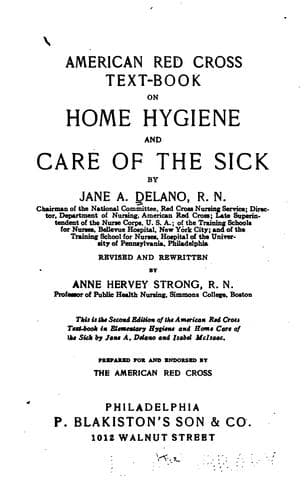
American Red Cross Text-Book on Home Hygiene and Care of the SickAmerican National Red Cross
Science
American Red Cross Text-Book on Home Hygiene and Care of the Sick
American National Red Cross
Home nursing; Hygiene; Nurses; Nursing
SLEEPLESSNESS, like headache, has many possible causes, and effective
treatment consists in finding and removing them. Pain or discomfort of
any kind, fatigue, overwork, and worry are common causes. Sleeplessness
easily becomes a habit that may persist after its cause has been
removed; hence a person who has formed the habit of sleeplessness should
patiently strive to break the old habit and to substitute a better. A
careful hygienic régime is essential for the patient, exercise in the
open air, and cultivation of a hopeful and tranquil spirit. The diet
should be liberal, but light and unstimulating; tea and coffee should be
omitted, certainly during the latter part of the day. The patient should
spend rather a dull evening, avoiding excitement and mental exertion
that is difficult, even though pleasurable. He should retire early. A
hot tub or foot bath, and a hot drink at bed time may help to produce
sleep. The bedroom should be dark, cool, and well ventilated, the bed
comfortable and the covers light but warm. The patient should be told
that rest is the most important thing for him, and that he should not
try too hard to sleep nor worry if unsuccessful. The patient should try
to banish from his mind, at bed time, thoughts that are distressing, and
even those that are especially interesting. By using patience and
persistence most persons can regain the power of sleeping even when
habits of sleeplessness have been long established.
FAINTING is a partial or total loss of consciousness due to a diminished
supply of blood in the brain. It may follow bleeding, exhaustion from
heat, fatigue from prolonged standing and the like, or strong emotional
disturbance, like fear or surprise. Fainting is less common than it
formerly was; it now occurs most frequently among persons suffering from
anæmia, heart weakness, or special susceptibility.
Symptoms of fainting are pale face, cold perspiration, rapid, feeble
pulse, and shallow, sighing respiration. Treatment consists in removing
the patient into cool, fresh air, applying cold water to the face and
keeping the head low. For a person who feels faint but has not lost
consciousness, this treatment will probably prove sufficient; if,
however, he becomes unconscious, place him so that the head is lower
than the body, loosen the clothing, especially the clothing about the
neck, apply cold water to the face and chest, and see that fresh air is
plentiful. When the patient is sufficiently conscious to swallow, give a
teaspoonful of aromatic spirits of ammonia in half a glass of water and
keep him quiet until he has entirely recovered.
Public-domain text, read in full here on John Shaqi.
Reviews
Reviews
No reviews yet
Be the first to share your thoughts on this work.
Elsewhere in the archive
Join the Discussion
Join the discussion
Sign in to leave a comment or review.
Sign InorCreate an account