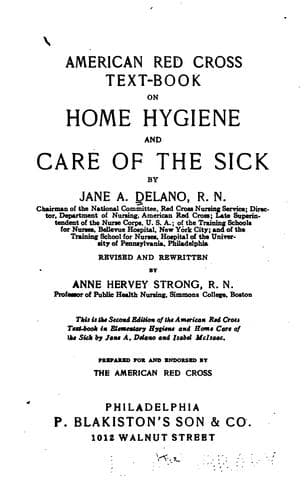
American Red Cross Text-Book on Home Hygiene and Care of the SickAmerican National Red Cross
Science
American Red Cross Text-Book on Home Hygiene and Care of the Sick
American National Red Cross
Home nursing; Hygiene; Nurses; Nursing
Symptoms of shock are pallor, pinched, anxious expression, dilated
pupils, cold clammy skin, feeble breathing, and rapid, weak pulse. The
patient may be mentally normal, or irrational, or unconscious, but more
frequently he appears stupid, and though conscious, he pays no attention
to what is going on. Unfortunately this condition is sometimes mistaken
for sleepiness, and he is left alone to sleep just when active measures
are most needed.
If a patient shows any symptom of shock the doctor should be summoned
immediately, but no time should be lost in beginning treatment, since
the condition may be critical. It should be remembered, however, that
panic and confusion may alarm a patient who is conscious, and thus
increase the shock. The patient should be covered warmly, and undressed
under blankets, without exposure or avoidable moving. His head should be
low, and as quickly as possible hot water bags should be placed near but
not upon him. If the patient is conscious and able to swallow he should
be given hot coffee or aromatic spirits of ammonia, one teaspoonful in
half a glass of water. The legs and arms should be rubbed from the
extremities toward the heart, but care should be taken to avoid touching
or moving injured parts. The patient should stay in bed, warmly covered
and closely watched for some time after he has apparently recovered.
Helping a patient into bed is not necessarily the first thing to be done
in every case of sudden illness. Great harm may be done by the
injudicious moving of injured persons, and often it is safer to make a
person comfortable with pillows and blankets where he happens to be,
certainly until a sufficient number of people can be found to lift him
properly. Clothing should be removed carefully, and one should not
hesitate to cut it away if undressing is painful or necessitates much
moving.
STIMULANTS, in emergency work, are frequently misused. They should not
be given when the head has been injured, when bleeding is profuse, or
when the face is red and the pulse strong. Neither should attempts be
made to give fluids of any kind to patients not sufficiently conscious
to swallow. Safe stimulants to use are black coffee, tea, or aromatic
spirits of ammonia. Alcoholic liquors should not be given unless
prescribed by a physician.
SUNSTROKE AND HEAT EXHAUSTION are both caused by excessive heat either
indoors or out, but they differ both in symptoms and in treatment.
Sunstroke or heat stroke, usually begins with acute pain in the head,
followed almost immediately by loss of consciousness. The skin is dry
and very hot, the face is red or purple, the pupils are dilated, the
breathing is difficult, the pulse is slow, and the temperature high.
Public-domain text, read in full here on John Shaqi.
Reviews
Reviews
No reviews yet
Be the first to share your thoughts on this work.
Elsewhere in the archive
Join the Discussion
Join the discussion
Sign in to leave a comment or review.
Sign InorCreate an account