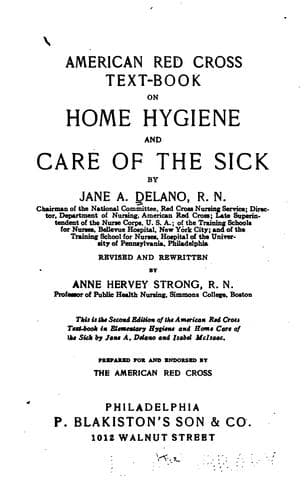
American Red Cross Text-Book on Home Hygiene and Care of the SickAmerican National Red Cross
Science
American Red Cross Text-Book on Home Hygiene and Care of the Sick
American National Red Cross
Home nursing; Hygiene; Nurses; Nursing
If abnormalities are found, a physician should be consulted. Often
corrective exercises are all that is needed, and no one should put
braces of any kind upon a child unless they have been prescribed by a
physician. No attempt should be made to correct the common tendency of
children to toe in or "walk pigeon-toed." Toeing-in is a natural manner
of walking during the formative period and tends to strengthen the arch
of the foot, while toeing-out tends to weaken the arch and to cause flat
foot or broken arches.
PREDISPOSITION TO NERVOUSNESS.--Heredity plays an important rôle in the
predisposition to nervousness, so that children of nervous parents are
particularly likely to show nervous instability. It is, however,
difficult to say in a given case how much of his nervousness a child
inherits and how much he acquires by imitating the irritability, the
out-breaks of temper, and the other evidences of imperfect emotional
control displayed by his nervously disposed parents. On the other hand,
even children of nervous predisposition sometimes overcome their defects
to some extent by imitating parents who have acquired self-control.
Children predisposed to nervousness should be watched with special care,
but they should not be allowed to realize that they are the objects of
unusual solicitude. They need the most favorable surroundings that can
be obtained, and their general health should be maintained at the
highest possible level. Any condition that lowers vitality tends to
increase their troubles; nervousness may be caused among children of
good inheritance, and increased among others, by poor nutrition, lack of
exercise and play out-of-doors, fatigue, loss of sleep, eyestrain,
adenoid growths, and the poisons of infectious diseases.
It is characteristic of many nervous children that they are too easily
stimulated; they may be excitable, restless, unnaturally quick in
moving, over-sensitive to pain and discomfort, easily fatigued,
irritable in temper, and unable to control the emotions. They frequently
make involuntary motions like grimacing and winking the eyes. Children
of low nervous tone, however, are not necessarily excitable. A nervous
child may be muscularly weak, awkward in gait, listless, dull, clumsy,
forgetful, and inattentive. Such children often suffer from cold hands
and feet and from profuse perspiration.
Much can be done for these unfortunate children by removing the cause of
their troubles if possible, by giving them simple and wholesome
surroundings, by suiting their occupations to their strength, by
eliminating mental strain, particularly during the adolescent period,
and by training them to control their minds as well as their bodies.
Public-domain text, read in full here on John Shaqi.
Reviews
Reviews
No reviews yet
Be the first to share your thoughts on this work.
Elsewhere in the archive
Join the Discussion
Join the discussion
Sign in to leave a comment or review.
Sign InorCreate an account