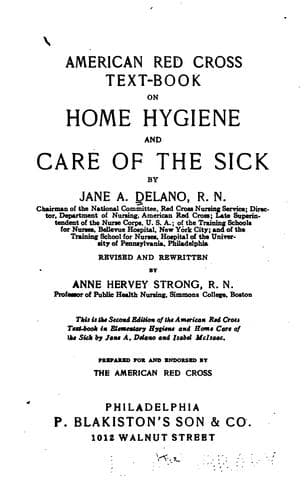
American Red Cross Text-Book on Home Hygiene and Care of the SickAmerican National Red Cross
Science
American Red Cross Text-Book on Home Hygiene and Care of the Sick
American National Red Cross
Home nursing; Hygiene; Nurses; Nursing
Among the most important changes that occur in the nervous system is its
gradual loss in power to respond to new demands. New habits are
difficult or impossible to form, and old habits are hard to break.
Attempts to break the habits of a life time are therefore dangerous, and
radical changes in old people's ways of living are attended by risk as
well as by unhappiness. Such loss of adaptability in the nervous system
makes it increasingly difficult for old people to assimilate new ideas
and to understand new points of view. The feeling that the world is
strange and that the next generation has gone on without them accounts
for the tragic loneliness of many old people. Clearly it is for those
who are younger and more flexible to bridge the gulf between the
generations by their understanding and their sympathy.
Physical care to whatever extent it is needed should be given to all old
people as soon as they are unable to care for themselves, and thought
should be given to adapting their surroundings and ways of living to
their strength and needs, just as they should be adapted to the strength
and needs of chronic patients. But a warning should be given against
managing old people too much. It is hard for people who have managed
their own lives successfully for many years to be managed, even for
their own good. Indeed, it is questionable kindness to deprive old
people of all freedom of action, even if following their own
inclinations occasionally has disastrous results. Few persons would wish
to prolong their lives if long life involved being thwarted in every
desire, and sometimes real kindness consists in allowing old people to
do certain things that are not good for them. Keeping them warm and
letting them do as they please will go far to make old people happy.
Many of the changes in old age reverse the developing process of
childhood. In youth and age extremes meet, and the care of the aged
presents certain marked similarities to the care of little children.
Both require simple food, occupations suited to their strength, and
protection from infections, from fatigue, and from nervous strain; both
are dependent, more or less helpless, and for their happiness both need
the affectionate care of their own families. But in one respect their
needs are fundamentally different. In childhood formation of proper
habits is all important, and in caring for children the future effect of
every word and act must be taken into consideration. Old people, on the
other hand, since they live largely in the past and their habits are
irrevocably formed, may be indulged without harm in ways that would
demoralize a child; with a clear conscience one may make them happy in
ways both great and small. This difference makes possible one of the
greatest pleasures that come to one who cares for the helpless and the
sick, for of all enduring satisfactions few are greater than the power
to fill with comfort and happiness the closing days of life.
EXERCISES
Public-domain text, read in full here on John Shaqi.
Reviews
Reviews
No reviews yet
Be the first to share your thoughts on this work.
Elsewhere in the archive
Join the Discussion
Join the discussion
Sign in to leave a comment or review.
Sign InorCreate an account