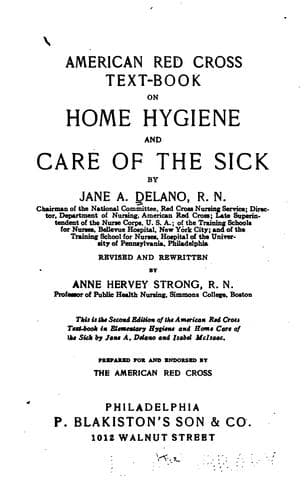
American Red Cross Text-Book on Home Hygiene and Care of the SickAmerican National Red Cross
Science
American Red Cross Text-Book on Home Hygiene and Care of the Sick
American National Red Cross
Home nursing; Hygiene; Nurses; Nursing
If a child is not in good health, it cannot keep up with its studies in
school. It is more likely to contract any contagious disease, and it has
not the proper chance to grow into a robust, healthy adult.
If the child's teeth are decayed, it should be taken to a dentist at
once.
The teeth should be brushed after each meal, using a tooth brush and
tooth powder.
The following tooth powder is recommended:
2 oz. powdered precipitated chalk.
½ oz. powdered Castile soap,
1 dram powdered orris root.
Thoroughly mix.
This prescription can be filled by any druggist at a cost not to exceed
fifteen cents.
DEPARTMENT OF HEALTH CITY OF NEW YORK
Instructions to Parents Regarding the Care of the Nose
The physical examination of school children shows that in many instances
they breathe through the mouth because they cannot breathe properly or
sufficiently through the nose.
This may be due to bad habits in regard to keeping the nose clean, or,
in a majority of instances, to a growth which is known as "adenoids" and
which stops up the back of the nose. In either case, the air is not
breathed through the nose, and the child becomes what is known as a
"mouth breather."
Constant breathing through the mouth causes the child to become pale,
restless in its sleep and dull in its actions. The child often speaks as
though it had a cold in the head. Frequently there is an almost constant
discharge from the nose.
Mouth breathing renders a child especially liable to contract
tuberculosis and other infectious diseases; in fact, the child has very
little resistance to disease of any kind.
Every child should be given a handkerchief, and be taught to thoroughly
blow the nose several times each day. If, after doing this regularly,
the child is still unable to breathe properly through the nose, it is
probable that an adenoid growth is present. Such children should be
taken to the family physician or to a dispensary for further advice and
treatment.
Do not wait too long in the hope that the child will outgrow the
condition, for the effect of adenoid growths persisting throughout
childhood may injure the person for life.
Have your child's throat and nose examined one month after measles,
scarlet fever, or diphtheria.
DEPARTMENT OF HEALTH CITY OF NEW YORK
Instructions to Parents on the Care of Children's Hair and Scalp
Children affected with vermin of the head are excluded from school. The
following directions will cure the condition:
Mix one-half pint of sweet oil and one-half pint of kerosene oil. Shake
the mixture well and saturate the hair with the mixture. Then wrap the
head in a large bath towel or rubber cap so that the head is entirely
covered; the head must remain covered from six to eight hours.
(Tincture of larkspur may be used instead of oil mixture. The directions
for use are the same.)
After removing the towel, the head should be shampooed as follows:
Public-domain text, read in full here on John Shaqi.
Reviews
Reviews
No reviews yet
Be the first to share your thoughts on this work.
Elsewhere in the archive
Join the Discussion
Join the discussion
Sign in to leave a comment or review.
Sign InorCreate an account