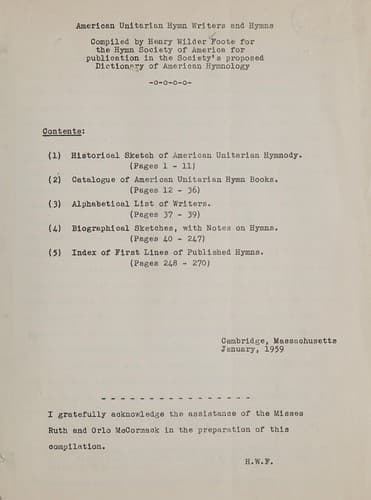
American Unitarian Hymn Writers and HymnsFoote, Henry Wilder
Religion
American Unitarian Hymn Writers and Hymns
Foote, Henry Wilder
Hymn writers; Hymns, English -- History and criticism; Unitarian Universalist churches -- Hymns -- History and criticism
Wilson, Rev. Edwin Henry, D.D. Chester Park, Long Island, New York,
August 23, 1898—still living. He graduated from Boston University,
1922; from Meadville Theological School, 1926; and took the degree of
M.A. at the University of Chicago, 1928. He has served as minister of
Unitarian churches in Chicago, Illinois; Schenectady, New York; and
Salt Lake City, Utah. Since 1949 he has been Director of the American
Humanist Association. His hymn beginning,
_Where is our holy church?_
written in 1928, is included in _Hymns of the Spirit_, 1937.
H.W.F.
Wilson, Rev. Lewis Gilbert, Southboro, Massachusetts, February 19,
1858—April 24, 1928, Floral City, Florida. He studied at Dartmouth,
Harvard and Meadville Theological School, and in 1883 was ordained
minister of the Unitarian Church at Leicester, Massachusetts. Later he
served the Unitarian church at Hopedale, Massachusetts, and from
1907-1915 was Secretary in the American Unitarian Association. While
there he was a member of the committee which edited _The New Hymn and
Tune Book_ published in 1914 by the Association. This book included
three of his hymns, beginning
1. _O God, our dwelling place_,
2. _O troubled sea of Galilee_,
3. _The works, O Lord, our hands have wrought_,
all three of which were written in 1912. The first of these is also
included in _Hymns of the Spirit_, 1937.
H.W.F.
Young, George H. (No information available)
A hymn of 4 stanzas, L.M., beginning,
_With heart’s glad song, dear Lord, we come_,
is attributed to him in the _Isles of Shoals Hymn Book_, 1908.
H.W.F.
FOOTNOTES
[1]Frederic M. Bird, an Episcopalian clergyman, then professor at
Lehigh University, in his day the leading authority on American
hymnody.
[2]Louis F. Benson, a Presbyterian clergyman, the successor of F. M.
Bird as the foremost American hymnologist in the first third of
this century.
[3]See accompanying Catalogue of American Unitarian Hymn Books.
[4]Julian’s _Dictionary_, p. 60, lists Huntington, with Eliza Scudder
and Harriet Beecher Stowe, as Episcopalian. It is true that
Huntington joined the Episcopal church in 1859, as did Miss Eliza
Scudder in her old age, but all the hymns produced by either of
them were written while they were still Unitarians in belief, and
Harriet Beecher Stowe was a life long Congregationalist.
Public-domain text, read in full here on John Shaqi.
Reviews
Reviews
No reviews yet
Be the first to share your thoughts on this work.
Elsewhere in the archive
Join the Discussion
Join the discussion
Sign in to leave a comment or review.
Sign InorCreate an account