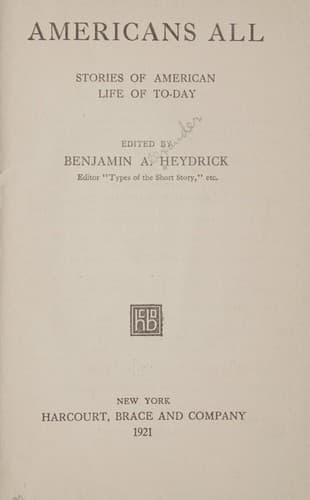
Short stories, American; United States -- Social life and customs -- Fiction
The beginning of a story is then for me in more than usual sensitiveness
to emotion. If this encounters the right focus (and heaven only knows
why it is the "right" one) I get simultaneously a strong thrill of
intense feeling, and an intense desire to pass it on to other people.
This emotion may be any one of the infinitely varied ones which life
affords, laughter, sorrow, indignation, gayety, admiration, scorn,
pleasure. I recognize it for the "right" one when it brings with it an
irresistible impulse to try to make other people feel it. And I know
that when it comes, the story is begun. At this point, the story begins
to be more or less under my conscious control, and it is here that the
work of construction begins.
"Flint and Fire" thus hovered vaguely in a shimmer of general emotional
tensity, and thus abruptly crystallized itself about a chance phrase and
the cadence of the voice which pronounced it. For several days I had
been almost painfully alive to the beauty of an especially lovely
spring, always so lovely after the long winter in the mountains. One
evening, going on a very prosaic errand to a farm-house of our region, I
walked along a narrow path through dark pines, beside a brook swollen
with melting snow, and found the old man I came to see, sitting silent
and alone before his blackened small old house. I did my errand, and
then not to offend against our country standards of sociability, sat for
half an hour beside him.
The old man had been for some years desperately unhappy about a tragic
and permanent element in his life. I had known this, every one knew it.
But that evening, played upon as I had been by the stars, the darkness
of the pines and the shouting voice of the brook, I suddenly stopped
merely knowing it, and felt it. It seemed to me that his misery emanated
from him like a soundless wail of anguish. We talked very little, odds
and ends of neighborhood gossip, until the old man, shifting his
position, drew a long breath and said, "Seems to me I never heard the
brook sound so loud as it has this spring." There came instantly to my
mind the recollection that his grandfather had drowned himself in that
brook, and I sat silent, shaken by that thought and by the sound of his
voice. I have no words to attempt to reproduce his voice, or to try to
make you feel as I did, hot and cold with the awe of that glimpse into a
naked human heart. I felt my own heart contract dreadfully with helpless
sympathy ... and, I hope this is not as ugly as it sounds, I knew at the
same instant that I would try to get that pang of emotion into a story
and make other people feel it.
That is all. That particular phase of the construction of the story
came and went between two heart-beats.
Public-domain text, read in full here on John Shaqi.
Reviews
Reviews
No reviews yet
Be the first to share your thoughts on this work.
Elsewhere in the archive
Join the Discussion
Join the discussion
Sign in to leave a comment or review.
Sign InorCreate an account