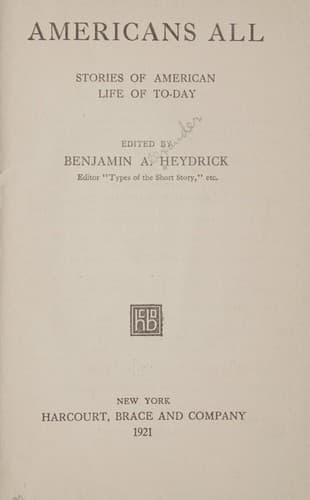
Short stories, American; United States -- Social life and customs -- Fiction
At this point the character of 'Niram's long-dead father came to life
and tried to push his way into the story, a delightful, gentle, upright
man, with charm and a sense of humor, such as none of the rest of my
stark characters possessed. I felt that he was necessary to explain the
fierceness of the sisters' rivalry for him. I planned one or two ways to
get him in, in retrospect--and liked one of the scenes better than
anything that finally was left in the story. Finally, very
heavy-hearted, I put him out of the story, for the merely material
reason that there was no room for him. As usual with my story-making,
this plot was sprouting out in a dozen places, expanding, opening up,
till I perceived that I had enough material for a novel. For a day or so
I hung undecided. Would it perhaps be better to make it a novel and
really tell about those characters all I knew and guessed? But again a
consideration that has nothing to do with artistic form, settled the
matter. I saw no earthly possibility of getting time enough to write a
novel. So I left Mr. Purdon out, and began to think of ways to compress
my material, to make one detail do double work so that space might be
saved.
One detail of the mechanism remained to be arranged, and this ended by
deciding the whole form of the story, and the first-person character of
the recital. This was the question of just how it would have been
materially possible for the bed-ridden old woman to break down the
life-long barrier between her and her sister, and how she could have
reached her effectively and forced her hand. I could see no way to
manage this except by somehow transporting her bodily to the sister's
house, so that she could not be put out on the road without public
scandal. This transportation must be managed by some character not in
the main action, as none of the persons involved would have been willing
to help her to this. It looked like putting in another character, just
for that purpose, and of course he could not be put in without taking
the time to make him plausible, human, understandable ... and I had just
left out that charming widower for sheer lack of space. Well, why not
make it a first person story, and have the narrator be the one who takes
Mrs. Purdon to her sister's? The narrator of the story never needs to be
explained, always seems sufficiently living and real by virtue of the
supremely human act of so often saying "I".
Public-domain text, read in full here on John Shaqi.
Reviews
Reviews
No reviews yet
Be the first to share your thoughts on this work.
Elsewhere in the archive
Join the Discussion
Join the discussion
Sign in to leave a comment or review.
Sign InorCreate an account