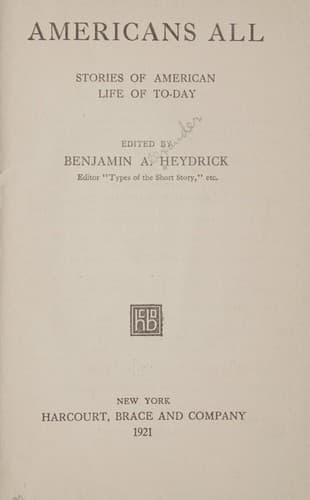
Short stories, American; United States -- Social life and customs -- Fiction
Then there is the traditional, obvious revision for suggestiveness, such
as the recurrent mention of the mountain brook at the beginning of each
of the first scenes; revision for ordinary sense, in the first draught I
had honeysuckle among the scents on the darkened porch, whereas
honeysuckle does not bloom in Vermont till late June; revision for
movement to get the narrator rapidly from her bed to the brook; for
sound, sense proportion, even grammar ... and always interwoven with
these mechanical revisions recurrent intense visualizations of the
scenes. This is the mental trick which can be learned, I think, by
practice and effort. Personally, although I never used as material any
events in my own intimate life, I can write nothing if I cannot achieve
these very definite, very complete visualizations of the scenes; which
means that I can write nothing at all about places, people or phases of
life which I do not intimately know, down to the last detail. If my life
depended on it, it does not seem to me I could possibly write a story
about Siberian hunters or East-side factory hands without having lived
long among them. Now the story was what one calls "finished," and I made
a clear copy, picking my way with difficulty among the alterations, the
scratched-out passages, and the cued-in paragraphs, the inserted pages,
the re-arranged phrases. As I typed, the interest and pleasure in the
story lasted just through that process. It still seemed pretty good to
me, the wedding still touched me, the whimsical ending still amused me.
But on taking up the legible typed copy and beginning to glance rapidly
over it, I felt fall over me the black shadow of that intolerable
reaction which is enough to make any author abjure his calling for ever.
By the time I had reached the end, the full misery was there, the
heart-sick, helpless consciousness of failure. What! I had had the
presumption to try to translate into words, and make others feel a
thrill of sacred living human feeling, that should not be touched save
by worthy hands. And what had I produced? A trivial, paltry, complicated
tale, with certain cheaply ingenious devices in it. I heard again the
incommunicable note of profound emotion in the old man's voice, suffered
again with his sufferings; and those little black marks on white paper
lay dead, dead in my hands. What horrible people second-rate authors
were! They ought to be prohibited by law from sending out their
caricatures of life. I would never write again. All that effort, enough
to have achieved a master-piece it seemed at the time ... and this,
_this_, for result!
From the subconscious depths of long experience came up the cynical,
slightly contemptuous consolation, "You know this never lasts. You
always throw this same fit, and get over it."
So, suffering from really acute humiliation and unhappiness, I went out
hastily to weed a flower-bed.
Public-domain text, read in full here on John Shaqi.
Reviews
Reviews
No reviews yet
Be the first to share your thoughts on this work.
Elsewhere in the archive
Join the Discussion
Join the discussion
Sign in to leave a comment or review.
Sign InorCreate an account