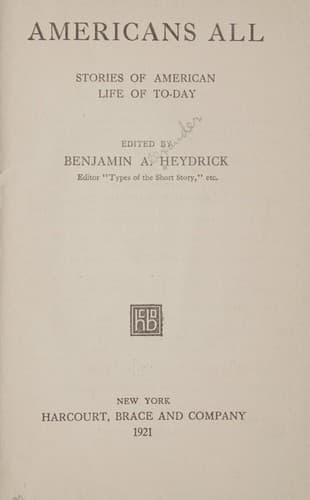
Short stories, American; United States -- Social life and customs -- Fiction
Meantime the Great War had come, and its summons was heard in their
quiet mountain home. Mr. Fisher went to France with the Ambulance Corps;
his wife as a war-relief worker. A letter from a friend thus described
her work:
She has gone on doing a prodigious amount of work. First running,
almost entirely alone, the work for soldiers blinded in battle,
editing a magazine for them, running the presses, often with her
own hands, getting books written for them; all the time looking out
for refugees and personal cases that came under her attention:
caring for children from the evacuated portions of France,
organizing work for them, and establishing a Red Cross hospital for
them.
Out of the fullness of these experiences she wrote her next book, _Home
Fires in France_, which at once took rank as one of the most notable
pieces of literature inspired by the war. It is in the form of short
stories, but only the form is fiction: it is a perfectly truthful
portrayal of the French women and of some Americans who, far back of the
trenches, kept up the life of a nation when all its people were gone. It
reveals the soul of the French people. _The Day of Glory_, her latest
book, is a series of further impressions of the war in France.
It is not often that an author takes us into his workshop and lets us
see just how his stories are written. The preceding account of Dorothy
Canfield's literary methods was written especially for this book.
DUSKY AMERICANS
_Most stories of Negro life fall into one of two groups. There is the
story of the Civil War period, which pictures the "darky" on the old
plantation, devoted to "young Massa" or "old Miss,"--the Negro of
slavery. Then there are stories of recent times in which the Negro is
used purely for comic effect, a sort of minstrel-show character. Neither
of these is the Negro of to-day. A truer picture is found in the stories
of Paul Laurence Dunbar. The following story is from his FOLKS FROM
DIXIE._
THE ORDEAL AT MT. HOPE
BY
PAUL LAURENCE DUNBAR
"And this is Mt. Hope," said the Rev. Howard Dokesbury to himself as he
descended, bag in hand, from the smoky, dingy coach, or part of a coach,
which was assigned to his people, and stepped upon the rotten planks of
the station platform. The car he had just left was not a palace, nor had
his reception by his fellow-passengers or his intercourse with them been
of such cordial nature as to endear them to him. But he watched the
choky little engine with its three black cars wind out of sight with a
look as regretful as if he were witnessing the departure of his dearest
friend. Then he turned his attention again to his surroundings, and a
sigh welled up from his heart. "And this is Mt. Hope," he repeated. A
note in his voice indicated that he fully appreciated the spirit of keen
irony in which the place had been named.
Public-domain text, read in full here on John Shaqi.
Reviews
Reviews
No reviews yet
Be the first to share your thoughts on this work.
Elsewhere in the archive
Join the Discussion
Join the discussion
Sign in to leave a comment or review.
Sign InorCreate an account