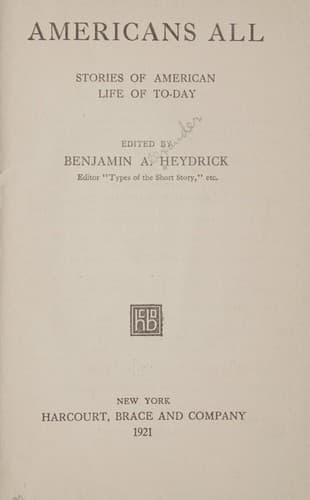
Short stories, American; United States -- Social life and customs -- Fiction
It was just before going to bed that, after a period of reflection, Aunt
Caroline began slowly: "We got a son"--her husband immediately bristled
up and his eyes flashed, but the old woman went on; "he named 'Lias, an'
we thinks a heap o' 'Lias, we does; but--" the old man had subsided, but
he bristled up again at the word--"he ain't jes' whut we want him to
be." Her husband opened his mouth as if to speak in defense of his son,
but was silent in satisfaction at his wife's explanation: "'Lias ain't
bad; he jes' ca'less. Sometimes he stays at home, but right sma't o' de
time he stays down at"--she looked at her husband and hesitated--"at de
colo'ed s'loon. We don't lak dat. It ain't no fitten place fu' him. But
'Lias ain't bad, he jes' ca'less, an' me an' de ol' man we 'membahs him
in ouah pra'ahs, an' I jes' t'ought I'd ax you to 'membah him too,
Brothah Dokesbury."
The minister felt the old woman's pleading look and the husband's
intense gaze upon his face, and suddenly there came to him an intimate
sympathy in their trouble and with it an unexpected strength.
"There is no better time than now," he said, "to take his case to the
Almighty Power; let us pray."
Perhaps it was the same prayer he had prayed many times before; perhaps
the words of supplication and the plea for light and guidance were the
same; but somehow to the young man kneeling there amid those humble
surroundings, with the sorrow of these poor ignorant people weighing
upon his heart, it seemed very different. It came more fervently from
his lips, and the words had a deeper meaning. When he arose, there was a
warmth at his heart just the like of which he had never before
experienced.
Aunt Caroline blundered up from her knees, saying, as she wiped her
eyes, "Blessed is dey dat mou'n, fu' dey shall be comfo'ted." The old
man, as he turned to go to bed, shook the young man's hand warmly and in
silence; but there was a moisture in the old eyes that told the minister
that his plummet of prayer had sounded the depths.
Alone in his own room Howard Dokesbury sat down to study the situation
in which he had been placed. Had his thorough college training
anticipated specifically any such circumstance as this? After all, did
he know his own people? Was it possible that they could be so different
from what he had seen and known? He had always been such a loyal Negro,
so proud of his honest brown; but had he been mistaken? Was he, after
all, different from the majority of the people with whom he was supposed
to have all thoughts, feelings, and emotions in common?
Public-domain text, read in full here on John Shaqi.
Reviews
Reviews
No reviews yet
Be the first to share your thoughts on this work.
Elsewhere in the archive
Join the Discussion
Join the discussion
Sign in to leave a comment or review.
Sign InorCreate an account