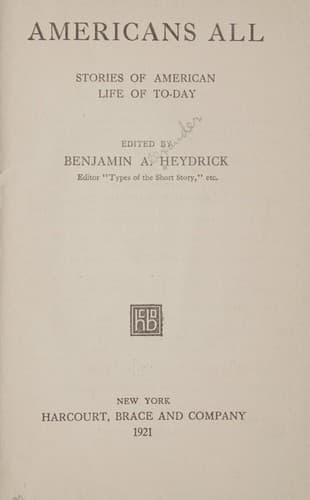
Short stories, American; United States -- Social life and customs -- Fiction
"I don't care what they say so long as it isn't true. Are you coming?"
"No, I ain't."
He was perfectly determined, and Dokesbury saw that there was no use
arguing with him. So with a resigned "All right!" he strode out the gate
and up the street, thinking of the problem he had to solve.
There was good in Elias Gray, he knew. It was a shame that it should be
lost. It would be lost unless he were drawn strongly away from the paths
he was treading. But how could it be done? Was there no point in his
mind that could be reached by what was other than evil? That was the
thing to be found out. Then he paused to ask himself if, after all, he
were not trying to do too much,--trying, in fact, to play Providence to
Elias. He found himself involuntarily wanting to shift the
responsibility of planning for the youth. He wished that something
entirely independent of his intentions would happen.
Just then something did happen. A piece of soft mud hurled from some
unknown source caught the minister square in the chest, and spattered
over his clothes. He raised his eyes and glanced about quickly, but no
one was in sight. Whoever the foe was, he was securely ambushed.
"Thrown by the hand of a man," mused Dokesbury, "prompted by the malice
of a child."
He went on his way, finished his business, and returned to the house.
"La, Brothah Dokesbury!" exclaimed Aunt Caroline, "what's de mattah 'f
you' shu't bosom?"
"Oh, that's where one of our good citizens left his card."
"You don' mean to say none o' dem low-life scoun'els----"
"I don't know who did it. He took particular pains to keep out of
sight."
"'Lias!" the old woman cried, turning on her son, "wha' 'd you let
Brothah Dokesbury go off by hisse'f fu? Why n't you go 'long an' tek
keer o' him?"
The old lady stopped even in the midst of her tirade, as her eyes took
in the expression on her son's face.
"I'll kill some o' dem damn----"
"'Lias!"
"'Scuse me, Mistah Dokesbury, but I feel lak I'll bus' ef I don't
'spress myse'f. It makes me so mad. Don't you go out o' hyeah no mo'
'dout me. I'll go 'long an' I'll brek somebody's haid wif a stone."
"'Lias! how you talkin' fo' de ministah?"
"Well, dat's whut I'll do, 'cause I kin outth'ow any of 'em an' I know
dey hidin'-places."
"I'll be glad to accept your protection," said Dokesbury.
He saw his advantage, and was thankful for the mud,--the one thing that
without an effort restored the easy relations between himself and his
protege.
Ostensibly these relations were reversed, and Elias went out with the
preacher as a guardian and protector. But the minister was laying his
nets. It was on one of these rambles that he broached to 'Lias a subject
which he had been considering for some time.
"Look here, 'Lias," he said, "what are you going to do with that big
back yard of yours?"
"Oh, nothin'. 'Tain't no 'count to raise nothin' in."
"It may not be fit for vegetables, but it will raise something."
"What?"
"Chickens. That's what."
Public-domain text, read in full here on John Shaqi.
Reviews
Reviews
No reviews yet
Be the first to share your thoughts on this work.
Elsewhere in the archive
Join the Discussion
Join the discussion
Sign in to leave a comment or review.
Sign InorCreate an account