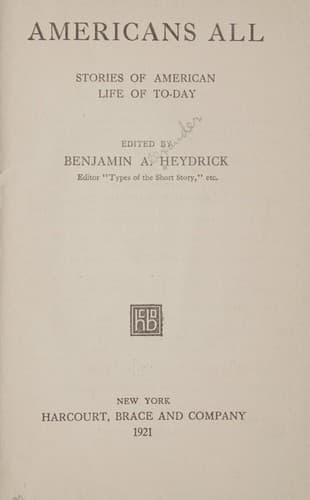
Short stories, American; United States -- Social life and customs -- Fiction
Meanwhile Clayton was gaining ground. It was less than two weeks before
election. The campaign waxed more and more bitter, and as the forces
opposed to him foresaw defeat, they became ugly in spirit, and
desperate. The _Telegraph_ took on a tone more menacing and brutal, and
Kittrell knew that the crisis had come. The might of the powers massed
against Clayton appalled Kittrell; they thundered at him through many
brazen mouths, but Clayton held on his high way unperturbed. He was
speaking by day and night to thousands. Such meetings he had never had
before. Kittrell had visions of him before those immense audiences in
halls, in tents, in the raw open air of that rude March weather, making
his appeals to the heart of the great mass. A fine, splendid, romantic
figure he was, striking to the imagination, this champion of the
people's cause, and Kittrell longed for the lost chance. Oh, for one day
on the _Post_ now!
One morning at breakfast, as Edith read the _Telegraph_, Kittrell saw
the tears well slowly in her brown eyes.
"Oh," she said, "it is shameful!" She clenched her little fists. "Oh, if
I were only a man I'd--" She could not in her impotent feminine rage say
what she would do; she could only grind her teeth. Kittrell bent his
head over his plate; his coffee choked him.
"Dearest," she said presently, in another tone, "tell me, how is he? Do
you--ever see him? Will he win?"
"No, I never see him. But he'll win; I wouldn't worry."
"He used to come here," she went on, "to rest a moment, to escape from
all this hateful confusion and strife. He is killing himself! And they
aren't worth it--those ignorant people--they aren't worth such
sacrifices."
He got up from the table and turned away, and then realizing quickly,
she flew to his side and put her arms about his neck and said:
"Forgive me, dearest, I didn't mean--only--"
"Oh, Edith," he said, "this is killing me. I feel like a dog."
"Don't dear; he is big enough, and good enough; he will understand."
"Yes; that only makes it harder, only makes it hurt the more."
That afternoon, in the car, he heard no talk but of the election; and
down-town, in a cigar store where he stopped for cigarettes, he heard
some men talking mysteriously, in the hollow voice of rumor, of some
sensation, some scandal. It alarmed him, and as he went into the office
he met Manning, the _Telegraph_'s political man.
"Tell me, Manning," Kittrell said, "how does it look?"
"Damn bad for us."
"For us?"
"Well, for our mob of burglars and second story workers here--the gang
we represent." He took a cigarette from the box Kittrell was opening.
"And will he win?"
"Will he win?" said Manning, exhaling the words on the thin level stream
of smoke that came from his lungs. "Will he win? In a walk, I tell you.
He's got 'em beat to a standstill right now. That's the dope."
"But what about this story of--"
Public-domain text, read in full here on John Shaqi.
Reviews
Reviews
No reviews yet
Be the first to share your thoughts on this work.
Elsewhere in the archive
Join the Discussion
Join the discussion
Sign in to leave a comment or review.
Sign InorCreate an account