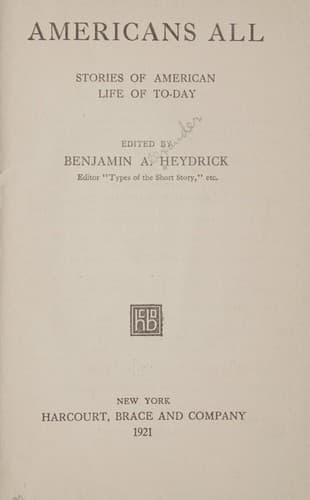
Short stories, American; United States -- Social life and customs -- Fiction
The rest of the story belongs to history. How he went back to Brussels;
how when the city seemed doomed, and all the government officials left,
he stayed on; how when the city was preparing to resist by force, he
went to Burgomaster Max and convinced him that it was useless, and so
saved the city from the fate of Louvain; how he took charge of the
relief work, how the King of Belgium thanked him for his services to the
country; how the city of Brussels in gratitude gave him a picture by Van
Dyck, a priceless thing, which he accepted--not for himself but for his
home city of Toledo; how after the war, he went back, not as Minister
but as Ambassador,--all these are among the proud memories of America's
part in the World War.
Brand Whitlock is so much more than an author that it is with an effort
that we turn to consider his literary work. His first book, _The
Thirteenth District_, published in 1902, was a novel of American
politics; it contains a capital description of a convention, and shows
the strategy of political leaders as seen by a keen observer. In _Her
Infinite Variety_ he dealt with the suffrage movement as it was in
1904, with determined women seeking the ballot, and equally determined
women working just as hard to keep it away from them. _The Happy
Average_ was a story of an every-day American couple: they were not
rich, nor famous, nor divorced,--yet the author thinks their story is
typical of most American lives. _The Turn of the Balance_ is a novel
that grew out of his legal experiences: it deals with the underworld of
crime, and often in a depressing way. It reflects the author's belief
that the present organization of society, and our methods of
administering justice, are the cause of much of the misery in the world.
Following these novels came two volumes of short stories, _The Gold
Brick_ and _The Fall Guy_: both deal with various aspects of American
life of to-day. In 1914 he published an autobiography under the title
_Forty Years of It_. This is interesting as a picture of political life
of the period in Ohio. His latest book, _Memories of Belgium under the
German Occupation_, tells the story of four eventful years. In all that
trying time, each night, no matter how weary he was, he forced himself
to set down the events of the day. From these records he wrote a book
that by virtue of its first-hand information and its literary art ranks
among the most important of the books called forth by the Great War.
THE TRAVELING SALESMAN
Public-domain text, read in full here on John Shaqi.
Reviews
Reviews
No reviews yet
Be the first to share your thoughts on this work.
Elsewhere in the archive
Join the Discussion
Join the discussion
Sign in to leave a comment or review.
Sign InorCreate an account