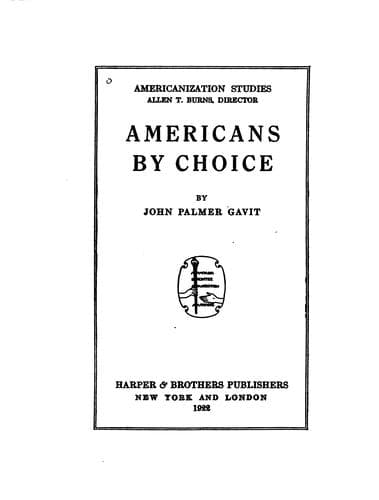
Americanization; Civics; Immigrants -- United States; Naturalization -- United States; Noncitizens -- United States
It is to the credit of Richard K. Campbell, Commissioner of
Naturalization, and Raymond F. Crist, his alert and enterprising
deputy, that they were prompt in seeing the bearing of the
Americanization movement upon their work. It is very easy now to
criticize, from various points of view, the energy and enthusiasm
with which the Bureau of Naturalization entered upon and increasingly
absorbed itself in this activity, and to fan flames of jealousy
between it and other organizations, governmental and what not, which
have worked in this field. The fact is that, with all credit to
others to which they may be entitled, the Bureau of Naturalization
early saw, not only the essentials of this question, but that it
was at bottom a question of education, and set itself to the task of
inspiring the public-school authorities to adapt themselves to the
situation, and of placing at their disposal, at least theoretically,
the unique material embodied in the archives of the Bureau. It is
regrettable, though hardly surprising, that, in doing so, it allowed
itself to become both swamped in the magnitude of the job, and
obsessed by a sense of proprietary precedence in the field; reaching
out beyond rhyme or reason for sweeping powers and responsibility
which it is ill-adapted to exercise, and, in that reaching out,
neglecting to carry on the important functions normally attaching to
its own business, and indispensable to the intelligent carrying out
even of its own ambitions.
With its report for the year closing June 30, 1915, begins the
recounting of activities of the Bureau in the new field. In so many
words it is there recognized as a new activity--“a broadening of
policy,” with a suggestion of justification, not to say apology, in
the allusion to the Act of March 4, 1913, confirming the Bureau in
charge of “all matters concerning the naturalization of aliens.”
As early as the latter part of 1913, the Bureau was discussing
methods of encouraging classes in citizenship, and “the elimination
of the known evils attending some of the private organizations
seeking, under the guise of instruction, to exploit the ignorance of
candidates for citizenship as an easy means for the acquisition of a
lucrative income” was referred to as one of the reforms that would
follow a co-operative activity between the public schools, the public
generally, and the Bureau of Naturalization.
Public-domain text, read in full here on John Shaqi.
Reviews
Reviews
No reviews yet
Be the first to share your thoughts on this work.
Elsewhere in the archive
Join the Discussion
Join the discussion
Sign in to leave a comment or review.
Sign InorCreate an account