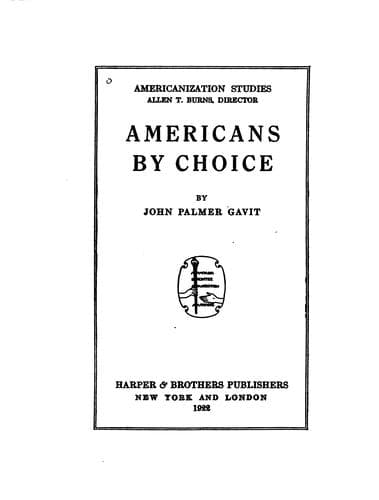
Americanization; Civics; Immigrants -- United States; Naturalization -- United States; Noncitizens -- United States
In the previous year, 1917-18, even though the war was already in
full blast, of 12,182 petitions denied more than two-thirds (8,422)
were denied for the strictly technical reason of “incompetent
witnesses,” “declaration invalid,” and “want of prosecution,” and
only 1,720 for “immoral character” and “ignorance.” In the last year
before the outbreak of the war (the fiscal year ending June 30,
1914), of 118,572 petitions disposed of, 13,133 were denied, most of
them (8,986) for these three reasons; only 1,735 for reasons going
definitely to the question of character and personal fitness embodied
in “immoral character” and “ignorance.” These figures are cited only
to emphasize the fact that up to the moment of the installation of
the system of military naturalization--and even after that time
outside of that system--the policy of meticulous vigilance was
maintained. In the six or seven weeks between the enactment of May
9th and the end of the fiscal June 30, 63,993 soldiers of foreign
birth were scooped into citizenship complete for every purpose.
One year later, June 30, 1919, the total number of these military
naturalizations had reached 128,335. The total number of petitions
granted in the entire period 1908-18, even including the military
naturalizations up to July 1, 1918, had been only 848,777.
Under the provisions now in view, aliens generally, who were in the
army, navy, marine corps, or United States merchant marine, who
had made declarations of intention, could be naturalized without
proof of five years’ residence in the United States, if it could be
shown that such residence could not be established; aliens in the
military service during the war could petition for naturalization
without previous declaration or proof of residence, and the machinery
of naturalization, hitherto enlisted in the cause of delay, was
now devoted to every possible expedition. Hearings were as nearly
immediate as possible. Aliens who had been accepted previously into
the military or naval service on condition of becoming citizens were
required to prove only three years’ residence. Honorable discharges
from previous service were accepted as evidence of both residence
and satisfactory character when supported by the evidence of two
witnesses, and where such persons were actually in the service there
was complete waiver of the requirement of certificates of arrival, as
well as of the usual ninety days’ posting and the statutory interval
of thirty days before an election.
Public-domain text, read in full here on John Shaqi.
Reviews
Reviews
No reviews yet
Be the first to share your thoughts on this work.
Elsewhere in the archive
Join the Discussion
Join the discussion
Sign in to leave a comment or review.
Sign InorCreate an account