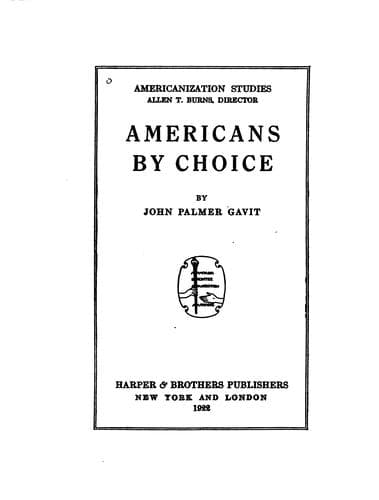
Americanization; Civics; Immigrants -- United States; Naturalization -- United States; Noncitizens -- United States
In 1915, in the capacity of a field investigator of the conditions
of unskilled labor for the United States Commission on Industrial
Relations, I happened to visit Port Arthur in the eastern part
of Texas, where a Standard Oil refinery is located. There was
some labor excitement. A young German, 22 or 23 years of age, who
had come to this country when a small boy and who was one of the
local leaders of the I. W. W., addressed a meeting. In attacking
all capitalists of all countries he also spoke of the war which,
according to him, was started and prosecuted by the czars, kaisers,
kings, and capitalists of all countries at the expense of the
working classes, etc., etc..
After the meeting I interviewed a number of local labor leaders.
The youthful orator was sitting on a lumber pile a few feet from
me. Oil barges were passing back and forth on the canal, carrying
oil from the refinery to a large British tanker in the harbor. The
boy intently watched the barges, and exclaimed, as if to himself,
in a low tone of disgust and desperation:
“Hm! Britain gets all the oil; Germany--nothing!”
All his reasoning, based upon international class solidarity, had
given way to his patriotic German heart!
There was, further, the inevitable influence of the fact that the
German Social Democracy has, on the whole, been more close-knit, more
effective in propaganda, and the German Socialist literature, from
Marx down, more widespread in its distribution, than the propaganda
in any other language. Even now, the Germans and pro-Germans in the
Socialist ranks habitually declare that the war was ended by the
German Social Democrats through a revolt against the Kaiser.
The native-born Americans, English, and other English-speaking
Socialists, most of whom had been in sympathy with the cause of
the Allies, revolted against the pacifist, antiwar, and pro-German
element in the Socialist party, and the turmoil shook the
organization to its foundation. The end of this is not yet; but one
big result in the Socialist party itself has been to reinforce the
influence of the moderate element and to some extent to drive the
extremists into the so-called Communist parties and the I. W. W.,
which, whatever else may be said of them, do not exercise themselves
directly about political affairs.
To the deep rift in the Socialist ranks on this account may be
attributed in large part the failure of the Socialists to live up
to their expectations and promises in the presidential election of
1920. It is far too soon to speculate with any confidence upon what
may be the course of political Socialism in the United States in the
years immediately before us when the emotions excited by the war die
down, the hysterical opposition to immigrants as such fades out, and
economic and industrial forces are permitted to operate “normally”
in their effects upon the motives of the working people and their
expression of those motives through their ballots.
Public-domain text, read in full here on John Shaqi.
Reviews
Reviews
No reviews yet
Be the first to share your thoughts on this work.
Elsewhere in the archive
Join the Discussion
Join the discussion
Sign in to leave a comment or review.
Sign InorCreate an account