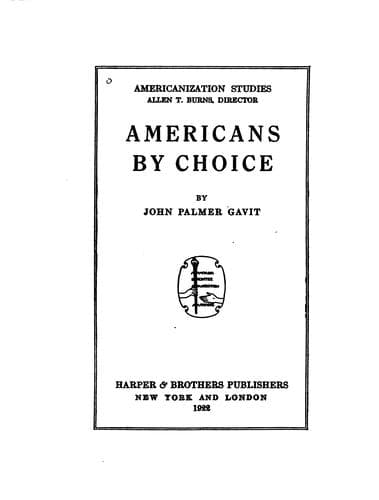
Americanization; Civics; Immigrants -- United States; Naturalization -- United States; Noncitizens -- United States
A fixed abiding place, a _home_, is psychologically a _sine qua
non_ of real and wholesome civic interest, as well as a legal
prerequisite for participation in public affairs. Theoretically,
a native-born or naturalized citizen has a membership in and duty
toward the United States. Actually, the degree of his participation
depends upon _the depths of his roots in some locality_, and the
relation of that locality to the civic unit toward whose welfare the
voter contributes, not only his taxes, but his personal interest. A
good part of the trouble with city government in New York, Chicago,
Philadelphia, Boston, and other great cities is due to the fact that
so many fine, public-spirited voters live in suburbs.
Thousands of the best men who participate in the daytime in the life
of New York City live in New Jersey and Connecticut, or, anyway,
in towns outside of Greater New York. Their real interests are in
New York, but they vote in another state. They contribute little to
the local welfare in the places Where they live because of their
real interest in New York. Consequently their civic vitality, so
to speak, is entirely lost to both communities--and to the United
States. The foreign-born voter in the crowded East Side of New York
is a far more effective citizen, for good or ill, than the presumably
more intelligent business man who cannot--or at any rate does
not--participate substantially in the political life either of the
city where his business and daily activities are carried on, or in
the village in another state where he has his legal residence.
Over against this anomalous condition put the case of the
well-meaning citizen, native or foreign born, who works for a certain
mining corporation in Illinois. The town where he lives belongs
absolutely to that corporation. It so happens that a part of the
mining property of that corporation lies in Illinois and a part in
Indiana. Under stress of business and mining conditions the company
suddenly moves the whole population, men, women, and children, over
the state line. What must happen then to any possible civic interest
or enthusiasm--supposing any to exist--on the part of American
citizens, voters, who had begun to think about the public interests
of the state of Illinois? What happens to the naturalization
proceedings begun by any alien to make himself a useful citizen of
his adopted country? How can any real civic interest live under such
conditions?
Public-domain text, read in full here on John Shaqi.
Reviews
Reviews
No reviews yet
Be the first to share your thoughts on this work.
Elsewhere in the archive
Join the Discussion
Join the discussion
Sign in to leave a comment or review.
Sign InorCreate an account