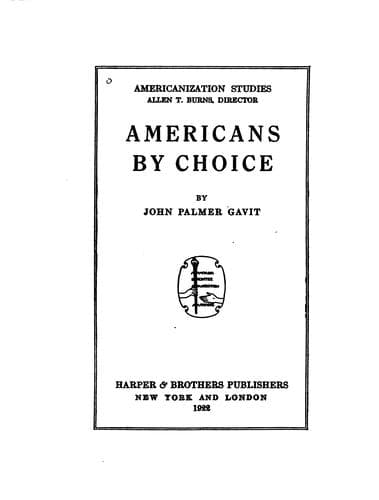
Americanization; Civics; Immigrants -- United States; Naturalization -- United States; Noncitizens -- United States
Theoretically, one might argue for a distinction to be made between
the general rights and responsibilities of bare citizenship (such
as diplomatic protection, the right to own property, exemption
from taxes imposed upon aliens as such, etc.) and the specific
right to vote. This, however, is almost completely academic,
because, except for the limitations of age and residence for a
period prior to election which apply alike to all citizens,
our Constitution--especially with the Nineteenth Amendment in
force--assumes that citizenship includes the ballot. It is difficult
to see any reason for requiring of the naturalized citizen, as a
qualification for voting, educational attainments other than those
required of the native born. It is equally difficult to see how
even a native-born citizen can be an intelligent voter if he cannot
speak and read the language in which the issues of elections are
discussed. Our own statistics of illiteracy, in states where the
proportion of the foreign born in the population is negligible, call
for educational measures having no exclusive reference to the foreign
born.
There is a growing custom in the courts, properly urged by the
Naturalization Bureau, of accepting, in lieu of any other educational
test, a certificate of graduation or proficiency from teachers in
public and other schools. The Naturalization Bureau now supplies the
forms for such certificates. A majority of the judges who answered
the questionnaire of the Americanization Study not only favored this
practice, but declared that it was their own. A good many, however--a
full third of those who expressed themselves on the subject--insisted
upon their own right and duty to examine the petitioner themselves,
or minimized the importance of the educational test altogether. It
seems obvious, however, that the certificate of properly accredited
American schools should be accepted for this purpose. Whatever may
be said in favor of having no educational test whatever, and of
admitting a petitioner who has no such certificate, there seems no
reason for not giving the petitioner the benefit of the extra credit
implied in his having attained such a graduation.
The declaration of intention (to become a citizen) should be
retained, notwithstanding the opinion of many persons, including some
attentive and discriminating students of the subject favoring its
abandonment. But the declaration in its present form and practice is
not satisfactory from any point of view. The procedure surrounding
it is now far too casual. It should be protected by substantial
safeguards and attended by a far greater degree of solemnity. Its
sufficiency in form, its technical correctness, should be certified
at the time of its issue by the officer of the court before whom it
is attested. There should be a preliminary period of residence in
this country before the declaration is made.
Public-domain text, read in full here on John Shaqi.
Reviews
Reviews
No reviews yet
Be the first to share your thoughts on this work.
Elsewhere in the archive
Join the Discussion
Join the discussion
Sign in to leave a comment or review.
Sign InorCreate an account