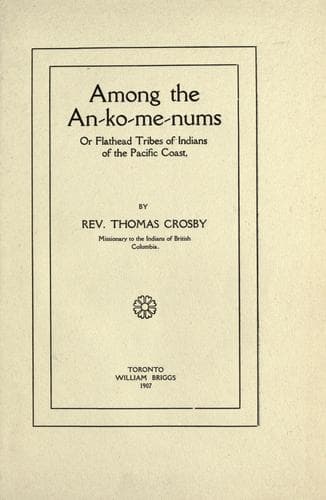
Among the An-ko-me-nums, or Flathead Tribes of Indians of the Pacific CoastCrosby, Thomas
History
Among the An-ko-me-nums, or Flathead Tribes of Indians of the Pacific Coast
Crosby, Thomas
Indians of North America -- Missions; Salish Indians
To-day, however, the eyes of the financial world are turned towards the
profitable investments in British Columbia. An ever-increasing number
of companies are establishing great saw-mills, and shipping lumber to
all parts of the world. Whereas once the Indian bands alone congregated
at the mouths of the great rivers during the fishing season, to gather
for their own consumption, now scores of large and magnificently
equipped canneries, employing large numbers of men, line the river
banks, and are engaged in packing salmon of different varieties as
well as other kinds of fish. The mountains in all directions are being
prospected for minerals, and fresh discoveries are being made almost
every day. Agriculture has advanced with the general advancement of
the country, and it is now known that there are millions of acres of
land suitable for cultivation which have not yet been settled upon.
In the raising of fruit, particularly, the opportunity is almost
unlimited, and some day the hillsides and benches which were thought
to be worthless will be planted with orchards. In a recent interview,
the Hon. R. G. Tatlow, Minister of Finance in the local Government, a
gentleman of wide experience and of twenty-six years’ residence in the
province, expressed himself as follows:
“I am satisfied that every industry in British Columbia is only in its
infancy. We have forests illimitable for lumber, land in millions of
acres for agriculture, and the seven thousand miles of shore line are
washed by seas teeming with fish.
“The total production of the province for the year ending June, 1906,
was over $50,000,000.
“Details of this production should be of public interest. Taking,
first, the lumber industry, the value of the lumber cut reached over
$6,500,000. The mineral output of the province was $22,461,325, with
eleven smelters in operation. Agriculture also advanced in common with
other lines of work during the year. The product of provincial farms
and orchards reached the sum of $6,500,000.
“There are splendid opportunities for mixed farming in many sections
of the province. The best evidence of this is the fact that we exported
butter, eggs, poultry and cheese to the value of nearly $2,000,000.
“Horticulture is rapidly coming to the front. It is becoming one of
our most important industries. In 1891 the acreage under fruit was
6,500; ten years later it had only reached 7,500, but advancement has
since been phenomenal. A year ago there were 22,000 acres cultivated by
orchardists and fruit-growers, and I fully believe that by the end of
1906 there will be 40,000 acres used in this manner.
“Fishing, of course, has long been an important item in the commerce of
the province, but even this industry shows signs of great expansion.
The total values from our fisheries amounted to $7,500,000.
“When one considers these facts, can there be the slightest doubt that
the present prosperity will be maintained?”
Public-domain text, read in full here on John Shaqi.
Reviews
Reviews
No reviews yet
Be the first to share your thoughts on this work.
Elsewhere in the archive
Join the Discussion
Join the discussion
Sign in to leave a comment or review.
Sign InorCreate an account