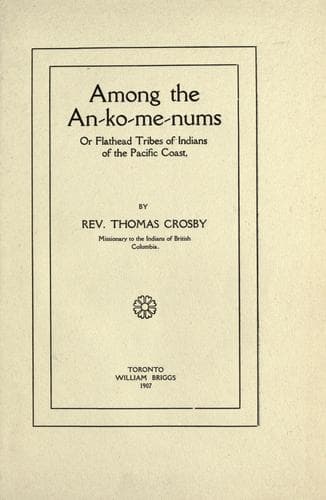
Among the An-ko-me-nums, or Flathead Tribes of Indians of the Pacific CoastCrosby, Thomas
History
Among the An-ko-me-nums, or Flathead Tribes of Indians of the Pacific Coast
Crosby, Thomas
Indians of North America -- Missions; Salish Indians
It was one of those cold, grey mornings in March which promise almost
anything, and the Indians were unwilling to start out so soon, thinking
that the weather was uncertain. We felt, however, that we must press on
or be too late for District Meeting.
When we got out some distance from shore we found a strong north-west
breeze after us, which, in a very little while, blew a gale of wind. We
now tried in vain to get back to shore; the wind blew so hard that we
could see the branches of the trees breaking off on the island behind
us. There was nothing left for us but to go before the wind, keeping
our course as well as we could straight for the main channel of the
Fraser River.
As the sea began to dash over us, the Dutch sailor shouted out, “Take
down the sail! Take down the sail!”
I told him to mind his own business and bail the water out. But again
he shouted frantically, “Take down the sail!”
“If you don’t stop you’ll have to go overboard,” I shouted at him. “Let
the Indians alone, they know more about managing a canoe than you do.”
It was clear to anyone that had the sail been taken down--we had furled
more than half of it--we would have been swamped in a very little
while, as it was the only thing that gave her headway.
As the great sea swept over us, three of us were kept bailing out,
while the other men managed the canoe. Every few minutes old Chilk
would shout, “Hold on! There is another great wave coming.” We would
grasp the side of the canoe and hold on for fear of being swept out,
and then to our bailing again every chance we had. Thus we dashed on
over the mighty, angry waves until we came to the sand heads at the
mouth of the Fraser, and were in danger of foundering on the bars.
It seemed as if that awful trip would never end, and yet every moment
we were busy, so busy that our exertions kept us warm, in spite of
the bleak March weather. At one time a tremendous wave broke over us,
followed by another, and still another, close after, and the canoe
dipped into the water as if she were going down nose first. The water
seemed to rush forward for a final plunge, while all held their breath,
expecting every moment to be submerged; then, all at once, she made a
lurch up with her bow and the water rushed back. When the old captain
saw hope he shouted, “Tlil-a-sit! tlil-a-sit! tlil-a-sit!” (“Bail out!
bail out!”) The very shout sent a thrill through everyone on board, and
we were bailing out as hard as we could to get the water down. It all
seemed done in less time than it takes to tell it.
[Illustration: “We were bailing out as hard as we could.” _p. 146_]
As we neared the mouth of the river the reason for this awful sea was
made clear. The waves raised by the gale met the mighty current of the
river, and the awful tide-rip at the sand heads was the worst we had to
pass through.
Public-domain text, read in full here on John Shaqi.
Reviews
Reviews
No reviews yet
Be the first to share your thoughts on this work.
Elsewhere in the archive
Join the Discussion
Join the discussion
Sign in to leave a comment or review.
Sign InorCreate an account