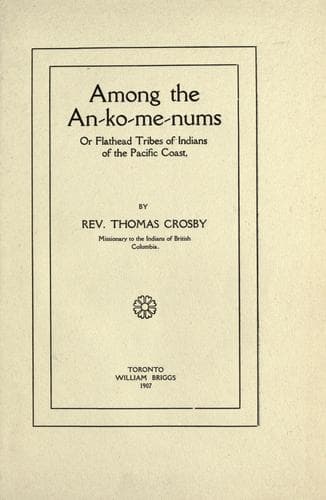
Among the An-ko-me-nums, or Flathead Tribes of Indians of the Pacific CoastCrosby, Thomas
History
Among the An-ko-me-nums, or Flathead Tribes of Indians of the Pacific Coast
Crosby, Thomas
Indians of North America -- Missions; Salish Indians
At that time there was no white man to be found settled on the Delta
lands of the Fraser. Soon after this the Ladner brothers took up land
on the south bank of the river and gave their name to the place. Then
followed Ferris on Lulu Island, and Boyd and Kilgour on Sea Island,
and others at different points, every one of whom was voted a fool for
“taking up” these swamps with cat-tails and bulrushes and frog-ponds.
Now these districts are covered with some of the most beautiful and
productive farms to be found in any part of the world. The shores are
lined with large canneries for the packing of salmon, and thousands of
people occupy these old-time mud-banks.
AN OLD CROAKER IN A CANOE.
It is the easiest thing in the world to find fault with people of
whose conditions and circumstances we know nothing. And sometimes a
little taste of the trials and toils which others have to endure is
the best cure for such unfair complainings. We had an old friend,
a Yorkshireman, on that coast, who was very apt to find fault with
others, and especially with the ministers.
“Thoo knoa thease preeachers have good teams wi’ theeir fat salaries,”
he would say. And then, seeing the gleam in my eye, he would hasten on:
“Ah dean’t mean you, thoo knoas. Ah mean thease men ’at ez t’ big fat
salaries; they can sit roond an’ dea vary little.”
“Stop your noise,” I would say to him. “I am a preacher, and don’t like
to hear you find fault with the ministers.”
On one occasion he came to me and asked when I was going to New
Westminster. When I told him and inquired why he wanted to know, he
said:
“Ah would like to gang wi’ you.”
“You can go with one understanding,” I replied.
“Weel, what is that?”
“That you work your passage. I never take deadheads with me.”
“Weel, Ah thinks Ah can paddle a little bit,” he said.
So the day came and off we started in our little canoe, down among the
lovely islands which dot the west side of the Gulf, and then across. I
was steering, an Indian sitting at the bow paddling, and our old friend
amidships. He was making a great, effort “to work his passage,” but not
being used to that kind of thing, he seemed to work his whole body in
the effort of paddling, and soon became very tired.
The day was quiet and warm, and we were making straight for Point
Grey, near the north arm of the Fraser River. After he had pulled
awhile, my friend looked round, and said:
“Ah say! do you knoa wot Ah thinks? ’At point deean’t seeam to get onny
nearer.”
“Yes,” I replied, “it gets nearer every stroke. Pull away! Preachers
get used to this kind of life.”
Then he pitched in again and made a great effort, while we were quietly
keeping stroke. We had not gone far, however, before he turned again
and said:
“Now, Ah can tell ye what it is, ’at point deean’t get onny nearer.”
“Of course it does,” I said; “every stroke brings us nearer. We must
push on to get in before it is too dark.” And we pulled on and on until
nine o’clock at night.
Public-domain text, read in full here on John Shaqi.
Reviews
Reviews
No reviews yet
Be the first to share your thoughts on this work.
Elsewhere in the archive
Join the Discussion
Join the discussion
Sign in to leave a comment or review.
Sign InorCreate an account