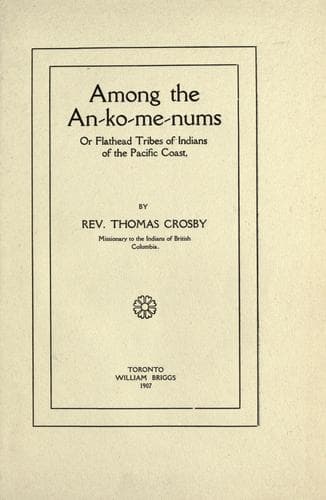
Among the An-ko-me-nums, or Flathead Tribes of Indians of the Pacific CoastCrosby, Thomas
History
Among the An-ko-me-nums, or Flathead Tribes of Indians of the Pacific Coast
Crosby, Thomas
Indians of North America -- Missions; Salish Indians
The united valleys contain upwards of 80,000 square acres of the
richest soil to be found anywhere in the world. A yield of sixty
bushels of wheat, or of sixty bushels of oats to the acre is quite
common, and some idea may be had of the marvellous fertility of
the soil when a meadow has been known to produce for twenty-five
consecutive years an average of three and a half tons of hay to the
acre, and that without having been re-seeded or fertilized otherwise
than by the pasturing of cattle. On the levels and along the foothills
an ever-increasing acreage of orchards--apples, pears, plums, prunes,
peaches and cherries--may be seen, and vegetables of all kinds are
grown in rich abundance.
This garden spot, beautiful for situation, the joy of all those whose
good fortune it is to live there, was at one time the home of great
bands of Indians belonging to the Flathead nation. Where to-day there
are eight small villages, there were thousands of people governed by
certain great chiefs, whose authority was respected to a great extent
throughout the whole valley. Their numbers have been reduced by disease
and by their terrible tribal wars. The Indians from Cowichan and the
coast made periodical incursions, massacring the people and burning
their property. Their enemies were not always successful, for on one
occasion, when the young men of the valley had gone down to work at
Langley and Victoria, and had secured their pay in blankets, as was
then the custom, the Cowichans became enraged at this interference
with what they considered their labor market, and, gathering a large
war party, they went up the old Chil-way-uk, prepared for the work
of murder and destruction. They were met, however, with a stout
resistance, their canoes were all captured and destroyed, and those who
were not killed were forced to make their way home again stealthily and
on foot.
The Indians still have traditions of the visit of the first white man
to the river, and of how the Gospel first came to the Chilliwack.
We have in this valley what many call a model settlement, whose people
are law-abiding, and whose business is carried on prosperously without
any liquor licenses. Not one was ever granted, and the people do not
want one to-day.
In 1808, when Simon Fraser made his way down the great river which now
bears his name, he landed opposite Chilliwack, at the mouth of what is
now known as the Harrison River. Here he was received by hundreds of
the natives, who thought, as they said, that “he was the pure white
child of the sun.” The chiefs carried him upon their backs and set him
down on mats in the place of honor, and then danced to the sun-god for
days in token of their appreciation of the visit of his son. It was not
long after that they discovered, when rum and disease followed in his
train, that the white man was not the pure child of the sun they had
imagined.
THE VISIT OF THE FIRST GOSPEL MESSENGER.
Public-domain text, read in full here on John Shaqi.
Reviews
Reviews
No reviews yet
Be the first to share your thoughts on this work.
Elsewhere in the archive
Join the Discussion
Join the discussion
Sign in to leave a comment or review.
Sign InorCreate an account