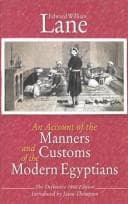
An account of the manners and customs of the modern EgyptiansLane, Edward William
History
An account of the manners and customs of the modern Egyptians
Lane, Edward William
Egypt -- Social life and customs
It is not very common for an Egyptian to have more than one wife, or a
concubine-slave, though the law allows him _four_ wives (as I have
before stated), and, according to common opinion, as many
concubine-slaves as he may choose. But though a man restrict himself to
a single wife, he may change as often as he desires; and there are
certainly not many persons in Cairo who have not divorced one wife, if
they have been long married. The husband may, whenever he pleases, say
to his wife, “Thou art divorced;” if it be his wish, whether reasonable
or not, she must return to her parents or friends. This liability to an
unmerited divorcement is the source of more uneasiness to many wives
than all the other troubles to which they are exposed; as they may
thereby be reduced to a state of great destitution; but to others, who
hope to better their condition, it is, of course, exactly the reverse. I
have mentioned, in a former chapter, that a man may divorce his wife
twice, and each time receive her again without any ceremony; but that he
cannot legally take her again after a third divorce until she has been
married and divorced by another man. The consequences of a triple
divorce conveyed in one sentence are the same, unless the man and his
wife agree to infringe the law, or the former deny his having pronounced
the sentence; in which latter case the woman may have much difficulty to
enforce his compliance with the law, if she be inclined to do so.
In illustration of this subject, I may mention a case in which an
acquaintance of mine was concerned as a witness of the sentence of
divorce. He was sitting in a coffee-shop with two other men, one of whom
had just been irritated by something that his wife had said or done.
After a short conversation upon this affair, the angry husband sent for
his wife, and as soon as she came, said to her, “Thou art trebly
divorced;” then addressing his two companions, he added, “You, my
brothers, are witnesses.” Shortly after, however, he repented of this
act, and wished to take back his divorced wife; but she refused to
return to him, and appealed to the “Shara Allah” (or Law of God). The
case was tried at the Mahkem′eh. The woman, who was the plaintiff,
stated that the defendant was her husband; that he had pronounced
against her the sentence of a triple divorce; and that he now wished her
to return to him, and live with him as his wife, contrary to the law,
and consequently in a state of sin. The defendant denied that he had
divorced her. “Have you witnesses?” said the judge to the plaintiff. She
answered, “I have here two witnesses.” These were the men who were
present in the coffee-shop when the sentence of divorce was pronounced.
They were desired to give their evidence, and they stated that the
defendant divorced his wife by a triple sentence, in their presence. The
defendant averred that she whom he had divorced in the coffee-shop was
another wife of his. The plaintiff declared that he had no other wife:
Public-domain text, read in full here on John Shaqi.
Reviews
Reviews
No reviews yet
Be the first to share your thoughts on this work.
Elsewhere in the archive
Join the Discussion
Join the discussion
Sign in to leave a comment or review.
Sign InorCreate an account