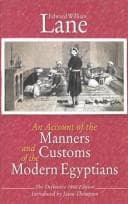
An account of the manners and customs of the modern EgyptiansLane, Edward William
History
An account of the manners and customs of the modern Egyptians
Lane, Edward William
Egypt -- Social life and customs
The Felláheen of Egypt cannot be justly represented in a very favourable
light with regard to their domestic and social condition and manners. In
the worst points of view, they resemble their Bedawee ancestors, without
possessing many of the virtues of the inhabitants of the desert, unless
in an inferior degree; and the customs which they have inherited from
their forefathers often have a very baneful effect upon their domestic
state. It has before been mentioned that they are descended from various
Arab tribes who have settled in Egypt at different periods; and that the
distinction of tribes is still preserved by the inhabitants of the
villages throughout this country. In the course of years, the
descendants of each tribe of settlers have become divided into numerous
branches, and these minor tribes have distinct appellations, which have
also often been given to the village or villages, or district, which
they inhabit. Those who have been longest established in Egypt have
retained less of Bedawee manners, and have more infringed the purity of
their race by intermarriages with Copt proselytes to the Muslim faith,
or with the descendants of such persons; hence, they are often despised
by the tribes more lately settled in this country, who frequently, in
contempt, term the former “Felláheen,” while they arrogate to themselves
the appellation of “Arabs” or “Bedawees.” The latter, whenever they
please, take the daughters of the former in marriage, but will not give
their own daughters in return; and if one of them be killed by a person
of the inferior tribe, they kill two, three, or even four, in
blood-revenge. The prevalence of the barbarous Bedawee law of
blood-revenge among the inhabitants of the villages of Egypt has been
mentioned in a former chapter: the homicide, or any person descended
from him, or from his great-grandfather’s father, is killed by any of
such relations of the person whom he has slain; and when the homicide
happens to be of one tribe, and the person killed of another, often a
petty war breaks forth between these two tribes, and is sometimes
continued, or occasionally renewed, during a period of several years.
The same is also frequently the result of a trifling injury committed by
a member of one tribe upon a person of another. In many instances, the
blood-revenge is taken a century or more after the commission of the act
which has occasioned it; when the feud, for that time, has lain dormant,
and perhaps is remembered by scarcely more than one individual. Two
tribes in Lower Egypt, which are called “Saad” and “Harám,” are most
notorious for these petty wars and feuds;[317] and hence their names are
commonly applied to any two persons or parties at enmity with each
other. It is astonishing that, in the present day, such acts (which, if
committed in a town or city in Egypt, would be punished by the death of,
perhaps, more than one of the persons concerned) should be allowed. Some
Public-domain text, read in full here on John Shaqi.
Reviews
Reviews
No reviews yet
Be the first to share your thoughts on this work.
Elsewhere in the archive
Join the Discussion
Join the discussion
Sign in to leave a comment or review.
Sign InorCreate an account