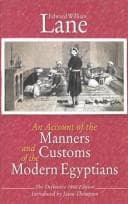
An account of the manners and customs of the modern EgyptiansLane, Edward William
History
An account of the manners and customs of the modern Egyptians
Lane, Edward William
Egypt -- Social life and customs
The Egyptians are extremely courteous to each other, and have a peculiar
grace and dignity in their manner of salutation and their general
demeanour, combined with easiness of address, which seem natural to
them, being observable even in the peasants. The middle and higher
classes of townspeople pride themselves upon their politeness and
elegance of manners, and their wit, and fluency of speech; and with some
justice: but they are not less free in their conversation than their
less accomplished fellow-countrymen. Affability is a general
characteristic of the Egyptians of all classes. It is common for
strangers, even in a shop, after mutual salutation, to enter into
conversation with each other with as much freedom as if they were old
acquaintances; and for one who has a pipe to offer it to another who has
none; and it is not unusual, nor is it generally considered unpolite,
for persons in a first, casual meeting, to ask each other’s names,
professions or trades, and places of abode. Lasting acquaintances are
often formed on such occasions.[328] In the middle and higher ranks of
Egyptian society, it is very seldom that a man is heard to say anything
offensive to the feelings of another in his company; and the most
profligate never venture to utter an expression meant to cast ridicule
upon sincere religion: most persons, however, in every class, are
otherwise more or less licentious in their conversation, and extremely
fond of joking. They are generally very lively and dramatic in their
talk; but scarcely ever noisy in their mirth. They seldom indulge in
loud laughter; expressing their enjoyment of anything ludicrous by a
smile or an exclamation.
-----
Footnote 318:
“’Aleykumu-s selámu wa-rahmatu-lláhi wa-barakátuh,” or merely
“’Aleykum es-selám” (On you be peace!); but the longer salutation is
more commonly used, in accordance with an injunction in the Kur-án,
chap. iv., ver. 88.
Footnote 319:
Very few Muslims in Egypt do so. A European traveller, not disguised
by Turkish dress, often fancies that he is greeted with this
salutation, when it is really intended for his Muslim attendant.
Footnote 320:
A Muslim, however, when he receives this salutation from a person of
another religion, sometimes replies, “And on you” (Wa-’aleykum).
Footnote 321:
Herodotus speaks of the respect paid in Egypt to the aged, and of the
polite salutations of the Egyptians to each other. (Lib. ii., cap.
80.)
Footnote 322:
Meaning, “I congratulate you on your safety,” and “I hope you are
well.”
Footnote 323:
Chap. xxiv., ver. 27.
Footnote 324:
Chap. vi., p. 162.
Footnote 325:
That is, to those who are above him either in office, wealth, or
religious or literary reputation.
Footnote 326:
The visitor, if superior, or not much inferior in rank to the master
of the house, receives his pipe and coffee before the latter.
Footnote 327:
Mentioned in Chap. v., p. 136.
Footnote 328:
Public-domain text, read in full here on John Shaqi.
Reviews
Reviews
No reviews yet
Be the first to share your thoughts on this work.
Elsewhere in the archive
Join the Discussion
Join the discussion
Sign in to leave a comment or review.
Sign InorCreate an account