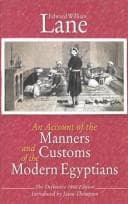
An account of the manners and customs of the modern EgyptiansLane, Edward William
History
An account of the manners and customs of the modern Egyptians
Lane, Edward William
Egypt -- Social life and customs
The Kutb, it is said, is often seen, but not known as such; and the same
is said of all who hold authority under him. He always has a humble
demeanour, and mean dress; and mildly reproves those whom he finds
acting impiously; particularly such as have a false reputation for
sanctity. Though he is unknown to the world, his favourite stations are
well known; yet at these places he is seldom visible. It is asserted
that he is almost constantly seated at Mekkeh, on the roof of the
Kaabeh; and, though never seen there, is always heard at midnight to
call twice, “O thou most merciful of those who show mercy!” which cry is
then repeated from the mád’nehs of the temple, by the muëddins: but a
respectable pilgrim, whom I have just questioned upon this matter, has
confessed to me that he himself has witnessed that this cry is made by a
regular minister of the mosque; yet that few pilgrims know this: he
believes, however, that the roof of the Kaabeh is the chief “markaz” (or
station) of the Kutb. Another favourite station of this revered and
unknown person is the gate of Cairo called Báb Zuweyleh, which is at the
southern extremity of that part of the metropolis which constituted the
old city; though now in the heart of the town; for the capital has
greatly increased towards the south, as it has also towards the west.
From its being a supposed station of this mysterious being, the Báb
Zuweyleh is commonly called “El-Mutawellee.”[355] One leaf of its great
wooden door (which is never shut), turned back against the eastern side
of the interior of the gateway, conceals a small vacant space, which is
said to be the place of the Kutb. Many persons, on passing by it, recite
the Fát’hah; and some give alms to a beggar who is generally seated
there, and who is regarded by the vulgar as one of the servants of the
Kutb. Numbers of persons afflicted with head-ache drive a nail into the
door, to charm away the pain; and many sufferers from the tooth-ache
extract a tooth, and insert it in a crevice of the door, or fix it in
some other way, to insure their not being attacked again by the same
malady. Some curious individuals often try to peep behind the door, in
the vain hope of catching a glimpse of the Kutb, should he happen to be
there, and not at the moment invisible. He has also many other stations,
but of inferior celebrity, in Cairo; as well as one at the tomb of the
seyyid Ahmad El-Bedawee, at Tanta; another at El-Mahalleh (which, as
well as Tanta, is in the Delta); and others in other places. He is
believed to transport himself from Mekkeh to Cairo in an instant; and so
also from any one place to another. Though he has a number of favourite
stations, he does not abide solely at these; but wanders throughout the
whole world, among persons of every religion, whose appearance, dress,
and language he assumes; and distributes to mankind, chiefly through the
agency of the subordinate welees, evils and blessings, the awards of
destiny.
Public-domain text, read in full here on John Shaqi.
Reviews
Reviews
No reviews yet
Be the first to share your thoughts on this work.
Elsewhere in the archive
Join the Discussion
Join the discussion
Sign in to leave a comment or review.
Sign InorCreate an account