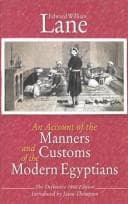
An account of the manners and customs of the modern EgyptiansLane, Edward William
History
An account of the manners and customs of the modern Egyptians
Lane, Edward William
Egypt -- Social life and customs
employ their time in repeating the testimony of the faith, imploring
forgiveness, praising God, etc.
Almost all the darweeshes of Egypt are tradesmen or artisans or
agriculturists; and only occasionally assist in the rites and ceremonies
of their respective orders: but there are some who have no other
occupations than those of performing zikrs at the festivals of saints
and at private entertainments, and of chanting in funeral processions.
These are termed “fukara,” or “fakeers”; which is an appellation given
also to the poor in general, but especially to poor devotees. Some
obtain their livelihood as water-carriers, by supplying the passengers
in the streets of Cairo, and the visitors at religious festivals, with
water, which they carry in an earthen vessel, or a goat’s skin on the
back. A few lead a wandering life, and subsist on alms; which they often
demand with great importunacy and effrontery. Some of these distinguish
themselves in the same manner as certain reputed saints before
mentioned, by the “dilk,” or coat of patches, and the staff with shreds
of cloth of different colours attached to the top: others wear fantastic
dresses of various descriptions.
Some Rifá’ee darweeshes (besides those who follow the occupation of
charming away serpents from houses) pursue a wandering life; travelling
about Egypt, and profiting by a ridiculous superstition which I must
here mention. A venerated saint called See[371] Dá-ood El-’Azab (or
Master David the Bachelor), who lived at Tefáhineh, a village in Lower
Egypt, had a calf, which always attended him, brought him water, etc.
Since his death, some Rifá’ee darweeshes have been in the habit of
rearing a number of calves at his native place, or burial place, above
named; teaching them to walk upstairs, to lie down at command, etc.; and
then going about the country, each with his calf, to obtain alms. The
calf is called “′Egl El-’Azab” (the Calf of El-’Azab, or,—of the
Bachelor). I once called into my house one of these darweeshes, with his
calf, the only one I have seen: it was a buffalo calf; and had two bells
suspended to it; one attached to a collar round his neck, and the other
to a girth round its body. It walked up the stairs very well; but showed
that it had not been very well trained in every respect. The ’Egl
El-’Azab is vulgarly believed to bring into the house a blessing from
the saint after whom it is called.
Public-domain text, read in full here on John Shaqi.
Reviews
Reviews
No reviews yet
Be the first to share your thoughts on this work.
Elsewhere in the archive
Join the Discussion
Join the discussion
Sign in to leave a comment or review.
Sign InorCreate an account