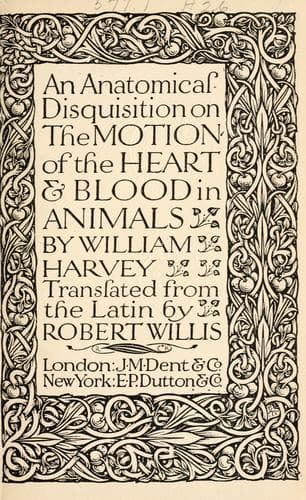
An anatomical disquisition on the motion of the heart & blood in animalsHarvey, William
Science
An anatomical disquisition on the motion of the heart & blood in animals
Harvey, William
Blood -- Circulation
I have myself pursued this subject of the anastomosis with all the
diligence I could command, and have given not a little both of time
and labour to the inquiry; but I have never succeeded in tracing any
connexion between arteries and veins by a direct anastomosis of their
orifices. I would gladly learn of those who give so much to Galen,
how they dare swear to what he says. Neither in the liver, spleen,
lungs, kidneys, nor any other viscus, is such a thing as an anastomosis
to be seen; and by boiling, I have rendered the whole parenchyma of
these organs so friable that it could be shaken like dust from the
fibres, or picked away with a needle, until I could trace the fibres
of every subdivision, and see every capillary filament distinctly. I
can therefore boldly affirm, that there is neither any anastomosis of
the vena portæ with the cava, of the arteries with the veins, or of
the capillary ramifications of the biliary ducts, which can be traced
through the entire liver, with the veins. This alone may be observed in
the recent liver: all the branches of the vena cava ramifying through
the convexity of the liver, have their tunics pierced with an infinity
of minute holes as is a sieve, and are fashioned to receive the blood
in its descent. The branches of the porta are not so constituted, but
simply spread out in subdivisions; and the distribution of these two
vessels is such, that whilst the one runs upon the convexity, the other
proceeds along the concavity of the liver to its outer margin, and all
the while without anastomosing.
In three places only do I find anything that can be held equivalent to
an anastomosis. From the carotids, as they are creeping over the base
of the brain, numerous interlaced fibres arise, which afterwards form
the choroid plexus, and passing through the lateral ventricles, finally
unite and terminate in the third sinus, which performs the office of
a vein. In the spermatic vessels, commonly called vasa præparantia,
certain minute arteries proceeding from the great artery adhere to the
venæ præparantes, which they accompany, and are at length taken in and
included within their coats, in such a way that they seem to have a
common ending, so that where they terminate on the upper portion of
the testis, on that cone-shaped process called the corpus varicosum et
pampiniforme, it is altogether uncertain whether we are to regard their
terminations as veins, or as arteries, or as both. In the same way are
the ultimate ramifications of the arteries which run to the umbilical
vein, lost in the tunics of this vessel.
Public-domain text, read in full here on John Shaqi.
Reviews
Reviews
No reviews yet
Be the first to share your thoughts on this work.
Elsewhere in the archive
Join the Discussion
Join the discussion
Sign in to leave a comment or review.
Sign InorCreate an account