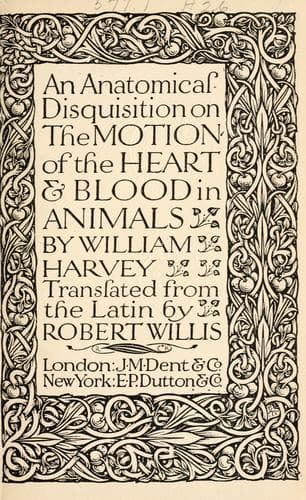
An anatomical disquisition on the motion of the heart & blood in animalsHarvey, William
Science
An anatomical disquisition on the motion of the heart & blood in animals
Harvey, William
Blood -- Circulation
In my book on the Motion of the Heart and Blood in Animals, I have
only adduced those facts from among many other observations, by which
either errors were best refuted, or truth was most strongly supported;
I have left many proofs, won by dissection and appreciable to sense,
as redundant and unnecessary; some of these, however, I now supply in
brief terms, for the sake of the studious, and those who have expressed
their desire to have them.
The authority of Galen is of such weight with all, that I have seen
several hesitate greatly with that experiment before them, in which
the artery is tied upon a tube placed within its cavity; and by which
it is proposed to prove that the arterial pulse is produced by a power
communicated from the heart through the coats of the arteries, and not
from the shock of the blood contained within them; and thence, that the
arteries dilate as bellows, are not filled as sacs. This experiment is
spoken of by Vesalius, the celebrated anatomist; but neither Vesalius
nor Galen says that he had tried the experiment, which, however, I
did. Vesalius only prescribes, and Galen advises it, to those anxious
to discover the truth, and for their better assurance, not thinking
of the difficulties that attend its performance, nor of its futility
when done; for indeed, although executed with the greatest skill,
it supplies nothing in support of the opinion which maintains that
the coats of the vessel are the cause of the pulse; it much rather
proclaims that this is owing to the impulse of the blood. For the
moment you have thrown your ligature around the artery upon the reed or
tube, immediately, by the force of the blood thrown in from above, it
is dilated beyond the circle of the tube, by which the flow is impeded,
and the shock is broken; so that the artery which is tied only pulsates
obscurely, being now cut off from the full force of the blood that
flows through it, the shock being reverberated, as it were, from that
part of the vessel which is above the ligature; but if the artery below
the ligature be now divided, the contrary of what has been maintained
will be apparent, from the spurting of the blood impelled through the
tube; just as happens in the cases of aneurism, referred to in my book
on the Motion of the Blood, which arise from an erosion of the coats of
the vessel, and when the blood is contained in a membranous sac, formed
not by the coats of the vessel dilated, but preternaturally produced
from the surrounding tissues and flesh. The arteries beyond an aneurism
of this kind will be felt beating very feebly, whilst in those above
it and in the swelling itself the pulse will be perceived of great
strength and fulness. And here we cannot imagine that the pulsation
and dilatation take place by the coats of the arteries, or any power
communicated to the walls of the sac; they are plainly due to the shock
of the blood.
Public-domain text, read in full here on John Shaqi.
Reviews
Reviews
No reviews yet
Be the first to share your thoughts on this work.
Elsewhere in the archive
Join the Discussion
Join the discussion
Sign in to leave a comment or review.
Sign InorCreate an account