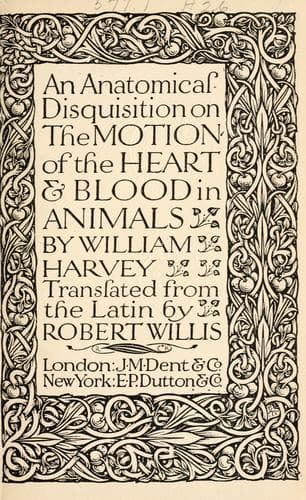
An anatomical disquisition on the motion of the heart & blood in animalsHarvey, William
Science
An anatomical disquisition on the motion of the heart & blood in animals
Harvey, William
Blood -- Circulation
Having brought forward this experiment I may observe, that a most
formidable objection to the circulation of the blood rises out of it,
which, however, has neither been observed nor adduced by any one who
has written against me. When we see by the experiment just described,
that the systole and diastole of the pulse can be accurately imitated
without any escape of fluid, it is obvious that the same thing may
take place in the arteries from the stroke of the heart, without the
necessity for a circulation, but like Euripus, with a mere motion of
the blood alternately backwards and forwards. But we have already
satisfactorily replied to this difficulty; and now we venture to say
that the thing could not be so in the arteries of a living animal;
to be assured of this it is enough to see that the right auricle is
incessantly injecting the right ventricle of the heart with blood, the
return of which is effectually prevented by the tricuspid valves; the
left auricle in like manner filling the left ventricle, the return
of the blood there being opposed by the mitral valves; and then the
ventricles in their turn are propelling the blood into either great
artery, the reflux in each being prevented by the sigmoid valves in
its orifice. Either, consequently, the blood must move on incessantly
through the lungs, and in like manner within the arteries of the body,
or stagnating and pent up, it must rupture the containing vessels,
or choke the heart by over distension, as I have shown it to do in
the vivisection of a snake, described in my book on the Motion of the
Blood. To resolve this doubt I shall relate two experiments among many
others, the first of which, indeed, I have already adduced, and which
show with singular clearness that the blood flows incessantly and with
great force and in ample abundance in the veins towards the heart. The
internal jugular vein of a live fallow deer having been exposed, (many
of the nobility and his most serene majesty the king, my master, being
present,) was divided; but a few drops of blood were observed to escape
from the lower orifice rising up from under the clavicle; whilst from
the superior orifice of the vein and coming down from the head, a
round torrent of blood gushed forth. You may observe the same fact any
day in practising phlebotomy: if with a finger you compress the vein a
little below the orifice, the flow of blood is immediately arrested;
but the pressure being removed, forthwith the flow returns as before.
Public-domain text, read in full here on John Shaqi.
Reviews
Reviews
No reviews yet
Be the first to share your thoughts on this work.
Elsewhere in the archive
Join the Discussion
Join the discussion
Sign in to leave a comment or review.
Sign InorCreate an account