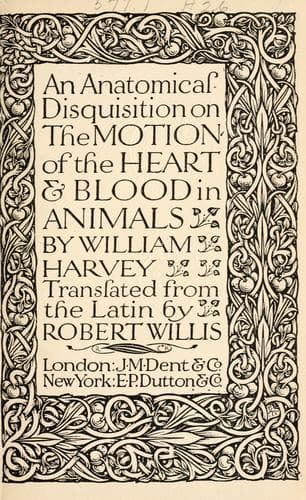
An anatomical disquisition on the motion of the heart & blood in animalsHarvey, William
Science
An anatomical disquisition on the motion of the heart & blood in animals
Harvey, William
Blood -- Circulation
I congratulate you much, most learned sir, on your excellent
commentary, in which you have replied in a very admirable manner to
Riolanus, the distinguished anatomist, and, as you say, formerly your
teacher: invincible truth has, indeed, taught the scholar to vanquish
the master. I was myself preparing a sponge for his most recent
arguments; but intent upon my work “On the Generation of Animals”
(which, but just come forth, I send to you), I have not had leisure
to produce it. And now I rather rejoice in the silence, as from your
supplement I perceive that it has led you to come forward with your
excellent reflections, to the common advantage of the world of letters.
For I see that in your most ornate book (I speak without flattery),
you have skilfully and nervously confuted all his machinations against
the circulation, and successfully thrown down the scaffolding of his
more recent opinions. I am, therefore, but little solicitous about
labouring at any ulterior answer. Many things might, indeed, be adduced
in confirmation of the truth, and several calculated to shed clearer
light on the art of medicine; but of these we shall perhaps see further
by and by.
Meantime, as Riolanus uses his utmost efforts to oppose the passage of
the blood into the left ventricle through the lungs, and brings it all
hither through the septum, and so vaunts himself upon having upset the
very foundations of the Harveian circulation (although I have nowhere
assumed such a basis for my doctrine; for there is a circulation in
many red-blooded animals that have no lungs), it may be well here to
relate an experiment which I lately tried in the presence of several
of my colleagues, and from the cogency of which there is no means
of escape for him. Having tied the pulmonary artery, the pulmonary
veins, and the aorta, in the body of a man who had been hanged, and
then opened the left ventricle of the heart, we passed a tube through
the vena cava into the right ventricle of the heart, and having, at
the same time, attached an ox’s bladder to the tube, in the same way
as a clyster-bag is usually made, we filled it nearly full of warm
water, and forcibly injected the fluid into the heart, so that the
greater part of a pound of water was thrown into the right auricle and
ventricle. The result was, that the right ventricle and auricle were
enormously distended, but not a drop of water or of blood made its
escape through the orifice in the left ventricle. The ligatures having
been undone, the same tube was passed into the pulmonary artery, and
a tight ligature having been put round it to prevent any reflux into
the right ventricle, the water in the bladder was now pushed towards
the lungs, upon which a torrent of the fluid, mixed with a quantity
of blood, immediately gushed forth from the perforation in the left
ventricle; so that a quantity of water, equal to that which was pressed
from the bladder into the lungs at each effort, instantly escaped by
the perforation mentioned.
Public-domain text, read in full here on John Shaqi.
Reviews
Reviews
No reviews yet
Be the first to share your thoughts on this work.
Elsewhere in the archive
Join the Discussion
Join the discussion
Sign in to leave a comment or review.
Sign InorCreate an account