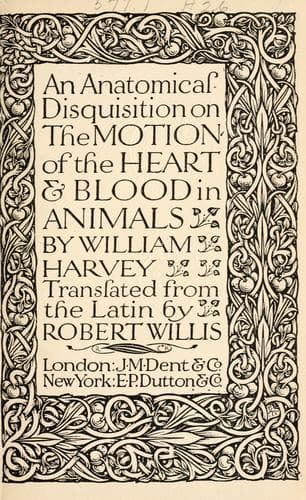
An anatomical disquisition on the motion of the heart & blood in animalsHarvey, William
Science
An anatomical disquisition on the motion of the heart & blood in animals
Harvey, William
Blood -- Circulation
DISTINGUISHED AND ACCOMPLISHED SIR,--The arrival of your letter lately
gave me the liveliest pleasure, and the receipt at the same time of
your learned comments upon Lucretius satisfied me that you are not
only living and well, but that you are at work among the sacred things
of Apollo. I do indeed rejoice to see truly learned men everywhere
illustrating the republic of letters, even in the present age, in
which the crowd of foolish scribblers is scarcely less than the swarms
of flies in the height of summer, and threatens with their crude and
flimsy productions to stifle us as with smoke. Among other things that
delighted me greatly in your book was that part where I see you ascribe
plague almost to the same efficient cause as I do animal generation.
Still it must be confessed that it is difficult to explain how the
idea, or form, or vital principle should be transfused from the genitor
to the genetrix, and from her transmitted to the conception or ovum,
and thence to the fœtus, and in this produce not only an image of the
genitor, or an external species, but also various peculiarities or
accidents, such as disposition, vices, hereditary diseases, nævi or
mother-marks, &c. All of these accidents must inhere in the geniture
and semen, and accompany that specific thing, by whatever name you
call it, from which an animal is not only produced, but by which it is
afterwards governed, and to the end of its life preserved. As all this,
I say, is not readily accounted for, so do I hold it scarcely less
difficult to conceive how pestilence or leprosy should be communicated
to a distance by contagion, by a zymotic element contained in woollen
or linen things, household furniture, even the walls of a house,
cement, rubbish, &c., as we find it stated in the fourteenth chapter
of Leviticus. How, I ask, can contagion, long lurking in such things,
leave them in fine, and after a long lapse of time produce its like
in another body? Nor in one or two only, but in many, without respect
of strength, sex, age, temperament, or mode of life, and with such
violence that the evil can by no art be stayed or mitigated. Truly
it does not seem less likely that form, or soul, or idea, whether
this be held substantive or accidental, should be transferred to
something else, whence an animal at length emerges, all as if it
had been produced on purpose, and to a certain end, with foresight,
intelligence, and divine art.
Public-domain text, read in full here on John Shaqi.
Reviews
Reviews
No reviews yet
Be the first to share your thoughts on this work.
Elsewhere in the archive
Join the Discussion
Join the discussion
Sign in to leave a comment or review.
Sign InorCreate an account