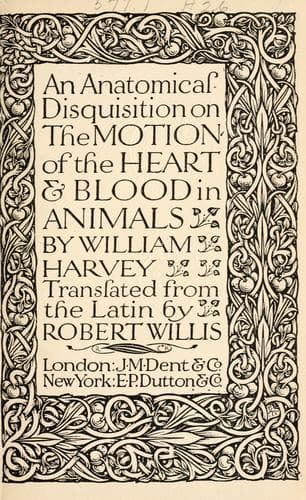
An anatomical disquisition on the motion of the heart & blood in animalsHarvey, William
Science
An anatomical disquisition on the motion of the heart & blood in animals
Harvey, William
Blood -- Circulation
With reference to your letters in reply, however, and in so far as
the collection of milky fluid in the vessels of Aselli is concerned,
I have not ascribed it to accident, and as if there were not certain
assignable causes for its existence; but I have denied that it was
found at all times in all animals, as the constant tenor of nutrition
would seem to require. Nor is it requisite that a matter, already
thin and much diluted, and which is to become fat after the ulterior
concoction, should concrete in the dead animal. The instance of pus, I
have adduced only incidentally and collaterally. The hinge upon which
our whole discussion turns is the assumption that the fluid contained
in the lacteal vessels of Aselli is chyle. This position I certainly
do not think you demonstrate satisfactorily, when you say that chyle
must be educed from the intestines, and that it can by no means be
carried off by the arteries, veins, or nerves; and thence conclude that
this function must be performed by the lacteals. I, however, can see no
reason wherefore the innumerable veins which traverse the intestines at
every point, and return to the heart the blood which they have received
from the arteries, should not, at the same time, also suck up the chyle
which penetrates the parts, and so transmit it to the heart; and this
the rather, as it seems probable that some chyle passes immediately
from the stomach before its contents have escaped into the intestines,
(or how account for the rapid recovery of the spirits and strength in
cases of fainting?) although no lacteals are distributed to the stomach.
With regard to the letter which you inform me you have addressed to
Bartholin, I do not doubt of his replying to you as you desire; nor
is there any occasion wherefore I should trouble you farther on that
topic. I only say (keeping silence as to any other channels), that
the nutritive juice might be as readily transported by the uterine
arteries, and distilled into the uterus, as watery fluid is carried
by the emulgent arteries to the kidneys. Nor can this juice be spoken
of as preternatural; neither ought it to be compared to the vagitus
uterinus, seeing that in pregnant women the fluid is always present,
the vagitus an incident of very rare occurrence. What you say of the
excrements of new-born infants differing from those of the child that
has once tasted milk I do not admit; for except in the particular of
colour, I scarcely perceive any difference between them, and conceive
that the black hue may fairly be ascribed to the long stay of the fæces
in the bowels.
Public-domain text, read in full here on John Shaqi.
Reviews
Reviews
No reviews yet
Be the first to share your thoughts on this work.
Elsewhere in the archive
Join the Discussion
Join the discussion
Sign in to leave a comment or review.
Sign InorCreate an account