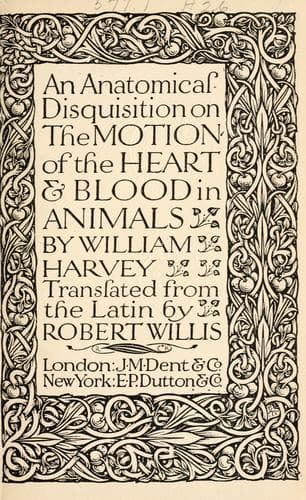
An anatomical disquisition on the motion of the heart & blood in animalsHarvey, William
Science
An anatomical disquisition on the motion of the heart & blood in animals
Harvey, William
Blood -- Circulation
Another union is that by the vena arteriosa, or pulmonary artery,
and is effected when that vessel divides into two branches after its
escape from the right ventricle of the heart. It is as if to the two
trunks already mentioned a third was superadded, a kind of arterial
canal, carried obliquely from the vena arteriosa, or pulmonary artery,
to perforate and terminate in the arteria magna or aorta. In the
embryo, consequently, there are, as it were, two aortas, or two roots
of the arteria magna, springing from the heart. This canalis arteriosus
shrinks gradually after birth, and is at length and finally almost
entirely withered, and removed, like the umbilical vessels.
The canalis arteriosus contains no membrane or valve to direct or
impede the flow of the blood in this or in that direction: for at the
root of the vena arteriosa, or pulmonary artery, of which the canalis
arteriosus is the continuation in the fœtus, there are three sigmoid
or semilunar valves, which open from within outwards, and oppose no
obstacle to the blood flowing in this direction or from the right
ventricle into the pulmonary artery and aorta; but they prevent all
regurgitation from the aorta or pulmonic vessels back upon the right
ventricle; closing with perfect accuracy, they oppose an effectual
obstacle to everything of the kind in the embryo. So that there is also
reason to believe that when the heart contracts, the blood is regularly
propelled by the canal or passage indicated from the right ventricle
into the aorta.
Public-domain text, read in full here on John Shaqi.
Reviews
Reviews
No reviews yet
Be the first to share your thoughts on this work.
Join the Discussion
Join the discussion
Sign in to leave a comment or review.
Sign InorCreate an account