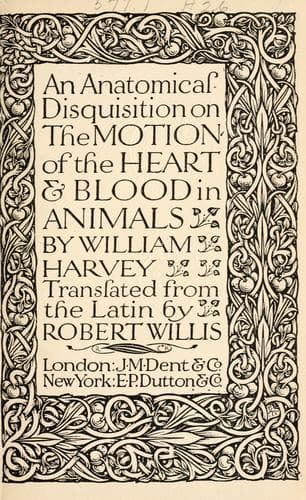
An anatomical disquisition on the motion of the heart & blood in animalsHarvey, William
Science
An anatomical disquisition on the motion of the heart & blood in animals
Harvey, William
Blood -- Circulation
And so, in all likelihood, does it come to pass in the body, through
the motion of the blood; the various parts are nourished, cherished,
quickened by the warmer, more perfect, vaporous, spirituous, and, as
I may say, alimentive blood; which, on the contrary, in contact with
these parts becomes cooled, coagulated, and, so to speak, effete;
whence it returns to its sovereign the heart, as if to its source,
or to the inmost home of the body, there to recover its state of
excellence or perfection. Here it resumes its due fluidity and
receives an infusion of natural heat--powerful, fervid, a kind of
treasury of life, and is impregnated with spirits, and it might be said
with balsam; and thence it is again dispersed; and all this depends on
the motion and action of the heart.
The heart, consequently, is the beginning of life; the sun of the
microcosm, even as the sun in his turn might well be designated the
heart of the world; for it is the heart by whose virtue and pulse
the blood is moved, perfected, made apt to nourish, and is preserved
from corruption and coagulation; it is the household divinity which,
discharging its function, nourishes, cherishes, quickens the whole
body, and is indeed the foundation of life, the source of all action.
But of these things we shall speak more opportunely when we come to
speculate upon the final cause of this motion of the heart.
Hence, since the veins are the conduits and vessels that transport the
blood, they are of two kinds, the cava and the aorta; and this not by
reason of there being two sides of the body, as Aristotle has it, but
because of the difference of office; nor yet, as is commonly said, in
consequence of any diversity of structure, for in many animals, as I
have said, the vein does not differ from the artery in the thickness
of its tunics, but solely in virtue of their several destinies and
uses. A vein and an artery, both styled vein by the ancients, and that
not undeservedly, as Galen has remarked, because the one, the artery
to wit, is the vessel which carries the blood from the heart to the
body at large, the other or vein of the present day bringing it back
from the general system to the heart; the former is the conduit from,
the latter the channel to, the heart; the latter contains the cruder,
effete blood, rendered unfit for nutrition; the former transmits the
digested, perfect, peculiarly nutritive fluid.
CHAPTER IX
THAT THERE IS A CIRCULATION OF THE BLOOD IS CONFIRMED FROM THE FIRST
PROPOSITION
Public-domain text, read in full here on John Shaqi.
Reviews
Reviews
No reviews yet
Be the first to share your thoughts on this work.
Elsewhere in the archive
Join the Discussion
Join the discussion
Sign in to leave a comment or review.
Sign InorCreate an account