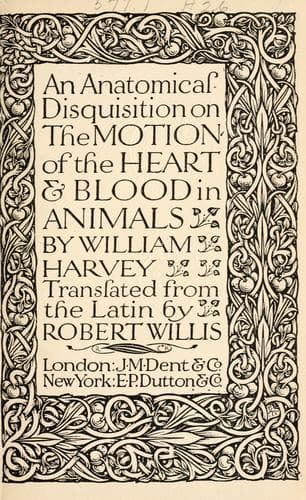
An anatomical disquisition on the motion of the heart & blood in animalsHarvey, William
Science
An anatomical disquisition on the motion of the heart & blood in animals
Harvey, William
Blood -- Circulation
three pounds and a half of blood injected into the aorta; but the body
of neither animal contains above four pounds of blood, a fact which I
have myself ascertained in the case of the sheep.
Upon this supposition, therefore, assumed merely as a ground for
reasoning, we see the whole mass of blood passing through the heart,
from the veins to the arteries, and in like manner through the lungs.
But let it be said that this does not take place in half an hour, but
in an hour, or even in a day; any way it is still manifest that more
blood passes through the heart in consequence of its action, than
can either be supplied by the whole of the ingesta, or than can be
contained in the veins at the same moment.
Nor can it be allowed that the heart in contracting sometimes propels
and sometimes does not propel, or at most propels but very little,
a mere nothing, or an imaginary something: all this, indeed, has
already been refuted; and is, besides, contrary both to sense and
reason. For if it be a necessary effect of the dilatation of the heart
that its ventricles become filled with blood, it is equally so that,
contracting, these cavities should expel their contents; and this not
in any trifling measure, seeing that neither are the conduits small,
nor the contractions few in number, but frequent, and always in some
certain proportion, whether it be a third, or a sixth, or an eighth,
to the total capacity of the ventricles, so that a like proportion of
blood must be expelled, and a like proportion received with each stroke
of the heart, the capacity of the ventricle contracted always bearing
a certain relation to the capacity of the ventricle when dilated. And
since in dilating, the ventricles cannot be supposed to get filled with
nothing, or with an imaginary something; so in contracting they never
expel nothing or aught imaginary, but always a certain something, viz.
blood, in proportion to the amount of the contraction. Whence it is to
be inferred, that if at one stroke the heart in man, the ox, or the
sheep, ejects but a single drachm of blood, and there are one thousand
strokes in half an hour, in this interval there will have been ten
pounds five ounces expelled: were there with each stroke two drachms
expelled, the quantity would of course amount to twenty pounds and ten
ounces; were there half an ounce, the quantity would come to forty-one
pounds and eight ounces; and were there one ounce, it would be as much
as eighty-three pounds and four ounces; the whole of which, in the
course of one half-hour, would have been transfused from the veins to
the arteries. The actual quantity of blood expelled at each stroke of
the heart, and the circumstances under which it is either greater or
less than ordinary, I leave for particular determination afterwards,
from numerous observations which I have made on the subject.
Public-domain text, read in full here on John Shaqi.
Reviews
Reviews
No reviews yet
Be the first to share your thoughts on this work.
Elsewhere in the archive
Join the Discussion
Join the discussion
Sign in to leave a comment or review.
Sign InorCreate an account