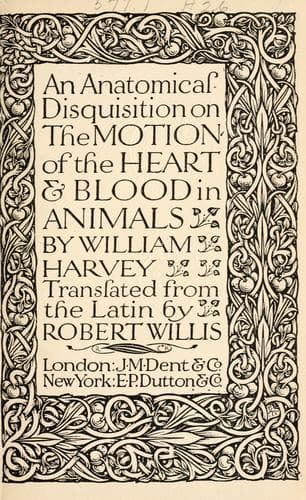
An anatomical disquisition on the motion of the heart & blood in animalsHarvey, William
Science
An anatomical disquisition on the motion of the heart & blood in animals
Harvey, William
Blood -- Circulation
If a live snake be laid open, the heart will be seen pulsating quietly,
distinctly, for more than an hour, moving like a worm, contracting
in its longitudinal dimensions, (for it is of an oblong shape,) and
propelling its contents; becoming of a paler colour in the systole,
of a deeper tint in the diastole; and almost all things else by which
I have already said that the truth I contend for is established, only
that here everything takes place more slowly, and is more distinct.
This point in particular may be observed more clearly than the noon-day
sun: the vena cava enters the heart at its lower part, the artery quits
it at the superior part; the vein being now seized either with forceps
or between the finger and thumb, and the course of the blood for some
space below the heart interrupted, you will perceive the part that
intervenes between the fingers and the heart almost immediately to
become empty, the blood being exhausted by the action of the heart;
at the same time the heart will become of a much paler colour, even in
its state of dilatation, than it was before; it is also smaller than at
first, from wanting blood; and then it begins to beat more slowly, so
that it seems at length as if it were about to die. But the impediment
to the flow of blood being removed, instantly the colour and the size
of the heart are restored.
If, on the contrary, the artery instead of the vein be compressed or
tied, you will observe the part between the obstacle and the heart, and
the heart itself, to become inordinately distended, to assume a deep
purple or even livid colour, and at length to be so much oppressed with
blood that you will believe it about to be choked; but the obstacle
removed, all things immediately return to their pristine state--the
heart to its colour, size, stroke, &c.
Here then we have evidence of two kinds of death: extinction from
deficiency, and suffocation from excess. Examples of both have now
been set before you, and you have had opportunity of viewing the truth
contended for with your own eyes in the heart.
CHAPTER XI
THE SECOND POSITION IS DEMONSTRATED
Public-domain text, read in full here on John Shaqi.
Reviews
Reviews
No reviews yet
Be the first to share your thoughts on this work.
Elsewhere in the archive
Join the Discussion
Join the discussion
Sign in to leave a comment or review.
Sign InorCreate an account