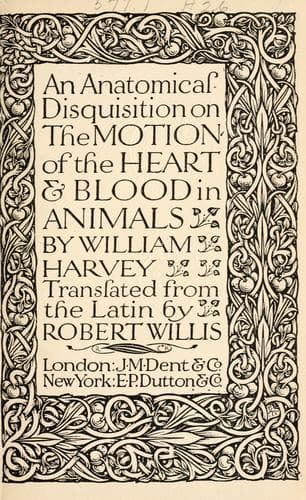
An anatomical disquisition on the motion of the heart & blood in animalsHarvey, William
Science
An anatomical disquisition on the motion of the heart & blood in animals
Harvey, William
Blood -- Circulation
Moreover, he whose arm or wrist has thus been bound for some little
time with the medium bandage, so that it has not only got swollen and
livid but cold, when the fillet is undone is aware of something cold
making its way upwards along with the returning blood, and reaching the
elbow or the axilla. And I have myself been inclined to think that this
cold blood rising upward to the heart was the cause of the fainting
that often occurs after blood-letting: fainting frequently supervenes
even in robust subjects, and mostly at the moment of undoing the
fillet, as the vulgar say, from the turning of the blood.
Farther, when we see the veins below the ligature instantly swell up
and become gorged, when from extreme tightness it is somewhat relaxed,
the arteries meantime continuing unaffected, this is an obvious
indication that the blood passes from the arteries into the veins,
and not from the veins into the arteries, and that there is either an
anastomosis of the two orders of vessels, or pores in the flesh and
solid parts generally that are permeable to the blood. It is farther
an indication that the veins have frequent communications with one
another, because they all become turgid together, whilst under the
medium ligature applied above the elbow; and if any single small vein
be pricked with a lancet, they all speedily shrink, and disburthening
themselves into this they subside almost simultaneously.
These considerations will enable any one to understand the nature of
the attraction that is exerted by ligatures, and perchance of fluxes
generally; how, for example, the veins when compressed by a bandage
of medium tightness applied above the elbow, the blood cannot escape,
whilst it still continues to be driven in, to wit, by the forcing
power of the heart, by which the parts are of necessity filled, gorged
with blood. And how should it be otherwise? Heat and pain and the _vis
vacui_ draw, indeed; but in such wise only that parts are filled, not
preternaturally distended or gorged, not so suddenly and violently
overwhelmed with the charge of blood forced in upon them, that the
flesh is lacerated and the vessels ruptured. Nothing of the kind as an
effect of heat, or pain, or the vacuum force, is either credible or
demonstrable.
Public-domain text, read in full here on John Shaqi.
Reviews
Reviews
No reviews yet
Be the first to share your thoughts on this work.
Elsewhere in the archive
Join the Discussion
Join the discussion
Sign in to leave a comment or review.
Sign InorCreate an account