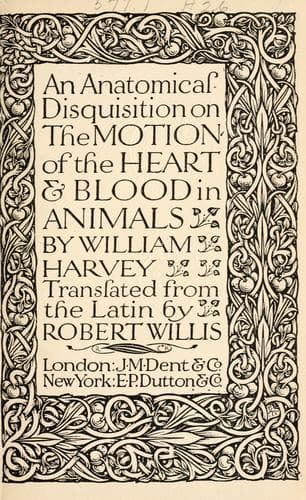
An anatomical disquisition on the motion of the heart & blood in animalsHarvey, William
Science
An anatomical disquisition on the motion of the heart & blood in animals
Harvey, William
Blood -- Circulation
But if all things be as they are now represented, we shall feel
ourselves at liberty to calculate the quantity of the blood, and
to reason on its circular motion. Should any one, for instance, in
performing phlebotomy, suffer the blood to flow in the manner it
usually does, with force and freely, for some half-hour or so, no
question but that the greatest part of the blood being abstracted,
faintings and syncopes would ensue, and that not only would the
arteries but the great veins also be nearly emptied of their contents.
It is only consonant with reason to conclude that in the course of
the half-hour hinted at, so much as has escaped has also passed from
the great veins through the heart into the aorta. And further, if we
calculate how many ounces flow through one arm, or how many pass in
twenty or thirty pulsations under the medium ligature, we shall have
some grounds for estimating how much passes through the other arm
in the same space of time; how much through both lower extremities,
how much through the neck on either side, and through all the other
arteries and veins of the body, all of which have been supplied with
fresh blood, and as this blood must have passed through the lungs and
ventricles of the heart, and must have come from the great veins,--we
shall perceive that a circulation is absolutely necessary, seeing
that the quantities hinted at cannot be supplied immediately from
the ingesta, and are vastly more than can be requisite for the mere
nutrition of the parts.
It is still further to be observed, that the truths contended for
are sometimes confirmed in another way; for having tied up the arm
properly, and made the puncture duly, still, if from alarm or any other
causes, a state of faintness supervenes, in which the heart always
pulsates more languidly, the blood does not flow freely, but distils by
drops only. The reason is, that with the somewhat greater than usual
resistance offered to the transit of the blood by the bandage, coupled
with the weaker action of the heart, and its diminished impelling
power, the stream cannot make its way under the fillet; and farther,
owing to the weak and languishing state of the heart, the blood is not
transferred in such quantity as wont from the veins to the arteries
through the sinuses of that organ. So also, and for the same reasons,
are the menstrual fluxes of women, and indeed hemorrhagies of every
kind, controlled. And now, a contrary state of things occurring,
the patient getting rid of his fear and recovering his courage, the
pulsific power is increased, the arteries begin again to beat with
greater force, and to drive the blood even into the part that is bound;
so that the blood now springs from the puncture in the vein, and flows
in a continuous stream.
CHAPTER XIII
THE THIRD POSITION IS CONFIRMED: AND THE CIRCULATION OF THE BLOOD IS
DEMONSTRATED FROM IT
Public-domain text, read in full here on John Shaqi.
Reviews
Reviews
No reviews yet
Be the first to share your thoughts on this work.
Elsewhere in the archive
Join the Discussion
Join the discussion
Sign in to leave a comment or review.
Sign InorCreate an account