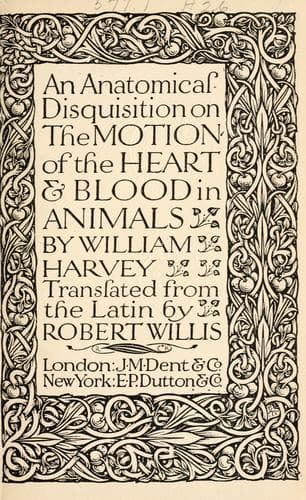
An anatomical disquisition on the motion of the heart & blood in animalsHarvey, William
Science
An anatomical disquisition on the motion of the heart & blood in animals
Harvey, William
Blood -- Circulation
The discoverer of these valves did not rightly understand their use,
nor have succeeding anatomists added anything to our knowledge: for
their office is by no means explained when we are told that it is to
hinder the blood, by its weight, from all flowing into inferior parts;
for the edges of the valves in the jugular veins hang downwards, and
are so contrived that they prevent the blood from rising upwards; the
valves, in a word, do not invariably look upwards, but always towards
the trunks of the veins, invariably towards the seat of the heart. I,
and indeed others, have sometimes found valves in the emulgent veins,
and in those of the mesentery, the edges of which were directed towards
the vena cava and vena portæ. Let it be added that there are no valves
in the arteries [save at their roots], and that dogs, oxen, &c., have
invariably valves at the divisions of their crural veins, in the veins
that meet towards the top of the os sacrum, and in those branches which
come from the haunches, in which no such effect of gravity from the
erect position was to be apprehended. Neither are there valves in the
jugular veins for the purpose of guarding against apoplexy, as some
have said; because in sleep the head is more apt to be influenced by
the contents of the carotid arteries. Neither are the valves present,
in order that the blood may be retained in the divarications or smaller
trunks and minuter branches, and not be suffered to flow entirely
into the more open and capacious channels; for they occur where there
are no divarications; although it must be owned that they are most
frequent at the points where branches join. Neither do they exist for
the purpose of rendering the current of blood more slow from the centre
of the body; for it seems likely that the blood would be disposed to
flow with sufficient slowness of its own accord, as it would have to
pass from larger into continually smaller vessels, being separated
from the mass and fountain head, and attaining from warmer into colder
places.
But the valves are solely made and instituted lest the blood should
pass from the greater into the lesser veins, and either rupture them
or cause them to become varicose; lest, instead of advancing from the
extreme to the central parts of the body, the blood should rather
proceed along the veins from the centre to the extremities; but the
delicate valves, while they readily open in the right direction,
entirely prevent all such contrary motion, being so situated and
arranged, that if anything escapes, or is less perfectly obstructed
by the cornua of the one above, the fluid passing, as it were, by the
chinks between the cornua, it is immediately received on the convexity
of the one beneath, which is placed transversely with reference to the
former, and so is effectually hindered from getting any farther.
Public-domain text, read in full here on John Shaqi.
Reviews
Reviews
No reviews yet
Be the first to share your thoughts on this work.
Elsewhere in the archive
Join the Discussion
Join the discussion
Sign in to leave a comment or review.
Sign InorCreate an account