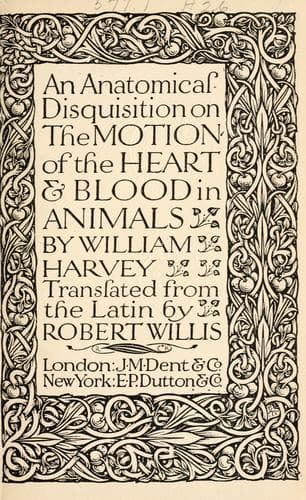
An anatomical disquisition on the motion of the heart & blood in animalsHarvey, William
Science
An anatomical disquisition on the motion of the heart & blood in animals
Harvey, William
Blood -- Circulation
There is but a single point which indeed would be more correctly placed
among our observations on the use of the spleen, but which it will not
be altogether impertinent to notice in this place incidentally. From
the splenic branch which passes into the pancreas, and from the upper
part, arise the posterior coronary, gastric, and gastroepiploic veins,
all of which are distributed upon the stomach in numerous branches and
twigs, just as the mesenteric vessels are upon the intestines; in like
manner, from the inferior part of the same splenic branch, and along
the back of the colon and rectum proceed the hemorrhoidal veins. The
blood returning by these veins, and bringing the cruder juices along
with it, on the one hand from the stomach, where they are thin, watery,
and not yet perfectly chylified; on the other thick and more earthy,
as derived from the fæces, but all poured into this splenic branch,
are duly tempered by the admixture of contraries; and nature mingling
together these two kinds of juices, difficult of coction by reason of
most opposite defects, and then diluting them with a large quantity of
warm blood, (for we see that the quantity returned from the spleen must
be very large when we contemplate the size of its arteries,) they are
brought to the porta of the liver in a state of higher preparation;
the defects of either extreme are supplied and compensated by this
arrangement of the veins.
CHAPTER XVII
THE MOTION AND CIRCULATION OF THE BLOOD ARE CONFIRMED FROM THE
PARTICULARS APPARENT IN THE STRUCTURE OF THE HEART, AND FROM THOSE
THINGS WHICH DISSECTION UNFOLDS
I do not find the heart as a distinct and separate part in all animals;
some, indeed, such as the zoophytes, have no heart; this is because
these animals are coldest, of no great bulk, of soft texture or of a
certain uniform sameness or simplicity of structure; among the number
I may instance grubs and earth-worms, and those that are engendered of
putrefaction and do not preserve their species. These have no heart, as
not requiring any impeller of nourishment into the extreme parts; for
they have bodies which are connate and homogeneous, and without limbs;
so that by the contraction and relaxation of the whole body they assume
and expel, move and remove the aliment. Oysters, mussels, sponges, and
the whole genus of zoophytes or plant-animals have no heart; for the
whole body is used as a heart, or the whole animal is a heart. In a
great number of animals, almost the whole tribe of insects, we cannot
see distinctly by reason of the smallness of the body; still in bees,
flies, hornets, and the like, we can perceive something pulsating with
the help of a magnifying glass; in pediculi, also, the same thing
may be seen, and as the body is transparent, the passage of the food
through the intestines, like a black spot or stain, may be perceived by
the aid of the same magnifying glass.
Public-domain text, read in full here on John Shaqi.
Reviews
Reviews
No reviews yet
Be the first to share your thoughts on this work.
Elsewhere in the archive
Join the Discussion
Join the discussion
Sign in to leave a comment or review.
Sign InorCreate an account