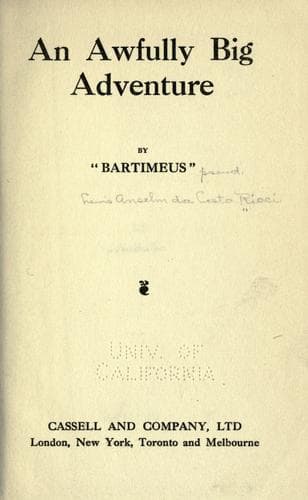
English fiction -- 20th century; Sea stories, English; War stories, English; World War, 1914-1918 -- Fiction
The Destroyer had sighted an enemy submarine on the surface at close
quarters during the night. The submarine had dived with commendable
promptitude, but not quite fast enough to avoid the nimbly
manœuvred Destroyer, who grated over her outer skin at thirty
knots. The conning tower of the submarine, which bumped along the
length of the Destroyer's side, was responsible for the
disinclination of the "A" bracket for anything but a merely passive
attitude towards the damaged propeller.
A couple of depth charges accelerated the submersion of the submarine
considerably, and the Destroyer made for the nearest harbour with
leaking stern-glands, and a ship's company uplifted beyond mere
jubilation.
The Commanding Officer went ashore to telegraph his report of the
incident, while the Chief Artificer Engineer and the Blacksmith put
their heads together over the fractured "A" bracket.
Ashore, the Lieutenant-Commander encountered the Chief Officer of the
Coastguard.
"Seein' as 'ow you're in the harbour, sir," said the Chief Officer,
"mebbe you'd like to land a party for the funeral this afternoon."
His tone was that of a man organising an entertainment under
difficulties. "This 'ere's a dull 'ole, an' a bit of a show would
liven 'em up like."
The Lieutenant, standing on the steps of the telegraph office, looked
up the sleepy street.
"Whose funeral?" he inquired.
"Party o' the name o' Jones," replied the C.O. in tones of melancholy
enjoyment. "Trimmer, Royal Naval Reserve, washed ashore near the
coastguard station. Mother attendin' funeral at 2 P.M. If you was
to land a firin' party, an' a bugler, an' mebbe half a dozen
mourners, sir, we could do the thing in style."
The Lieutenant mused in silence for a while. The "A" bracket would
take till five o'clock, and the funeral was at 2 P.M. "I can't
guarantee the mourners," he said, "but you can have the firing party
and the bugler. And if any of the men wish to attend as mourners,
I'll give them leave."
"Thank you, sir," said the Chief Officer. "The Boy Scouts from 'ere
is turning out, and the firemen from Nordbury, an' the lifeboat's
crew. They was all for 'avin' a collection afterwards in aid of the
institootion. But I sez to them----"
The Lieutenant-Commander had sighted a pink parasol, shading a white
muslin dress above neat ankles, that emerged from a shop farther down
the street. If he walked quickly enough he ought to be able to get a
glimpse of the face hidden by the parasol by the time he reached the
pier, where his gig was waiting. Two years of war in a Destroyer
quickens masculine interest in such problems. He descended the steps
hurriedly. "That'll be all right," he said. "The party'll be at the
landing-place at one-thirty," and hastened down the street in the
wake of the pink parasol.
Twenty minutes later he was climbing on board his Destroyer.
Public-domain text, read in full here on John Shaqi.
Reviews
Reviews
No reviews yet
Be the first to share your thoughts on this work.
Elsewhere in the archive
Join the Discussion
Join the discussion
Sign in to leave a comment or review.
Sign InorCreate an account