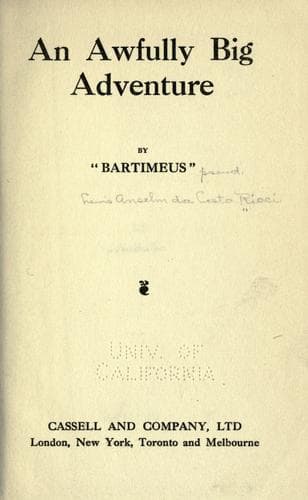
English fiction -- 20th century; Sea stories, English; War stories, English; World War, 1914-1918 -- Fiction
For two hours the train from Nice had crossed and recrossed the River
Var, as if uncertain which bank it should pursue. The journey had
been punctuated by stoppages at innumerable small stations,
apparently to enable the engine-driver to discuss politics with the
proprietors of adjacent sawmills. The guard took no part in these
discussions, but remained aloof--albeit within earshot--until his
_confrère_ on the engine had scored his point. Then he blew a
discordant blast on his horn, the driver climbed triumphantly back on
to his engine, and we jolted on to the next political tourney-place.
Where the valley widens the line appeared to make up its mind and to
decide definitely for the right bank. The sawmills and patches of
Indian corn gave place to orchards and pretty farms; the mountains on
either flank of the valley towered to more majestic altitudes. For
perhaps the tenth time the brakes screeched, and we came to a
standstill beside a deserted platform.
"Touet de Beuil!" said the guard gruffly, coming round to the
carriage window. He was a man of few words, who appeared content to
rely on the trumpet for any expression of his views or feelings.
"_Oui, oui!_" he confirmed irritably as I climbed out, slightly
incredulous. "_C'est ça_--Touet de Beuil--_V'là_!" He jerked his
thumb over his shoulder at the mountains which frowned above us; the
horn blared forth a shrill note of defiance, and he swung himself on
to the departing train.
I looked up to where he had indicated, and there, sure enough,
perched crazily among pinnacles and buttresses of rock, was what
appeared to be the stronghold of some medieval outlaw. I detected
the brown roofs and quaint gables of a hamlet, apparently accessible
to none but the eagles, yet boasting in this land of equality and
fraternity a railway station of its own.
Footsteps approached me as I stood adjusting the straps of my
knapsack, and one of the inhabitants hurried down the lane on to the
platform. Childish though it may seem, I was frankly disappointed.
The new arrival was a meek-looking little man dressed in black,
wearing a bowler hat. In one hand he carried a gingham umbrella, and
under his arm a buff-coloured hen of singular imperturbability. Now
a brigand may wear a bowler hat; moreover, he may carry a chicken
under his arm, and yet preserve an air of outlawry. But to descend
from a mountain fastness that belonged by rights to the sixteenth
century and brandish an umbrella at a departing train was carrying
the incongruous a shade too far.
True, he swore roundly, as every good brigand should, at having
missed the train. But I could not forgive him his gingham gamp.
Public-domain text, read in full here on John Shaqi.
Reviews
Reviews
No reviews yet
Be the first to share your thoughts on this work.
Elsewhere in the archive
Join the Discussion
Join the discussion
Sign in to leave a comment or review.
Sign InorCreate an account