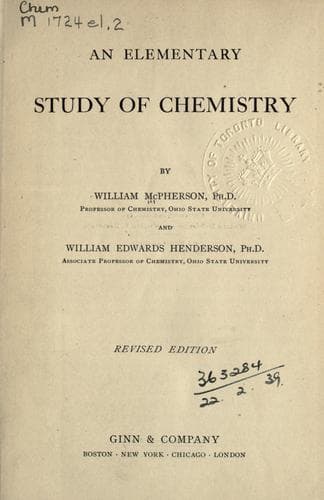
An Elementary Study of ChemistryMcPherson, William
Science
An Elementary Study of Chemistry
McPherson, William
Chemistry
18. How could you distinguish between a chloride, a bromide, and an
iodide?
19. What weight of sodium chloride is necessary to prepare sufficient
hydrochloric acid to saturate 1 l. of water under standard conditions?
20. On decomposition 100 l. of hydrochloric acid would yield how many
liters of hydrogen and chlorine respectively, the gases being measured
under the same conditions? Are your results in accord with the
experimental facts?
CHAPTER XVII
CARBON AND SOME OF ITS SIMPLER COMPOUNDS
~The family.~ Carbon stands at the head of a family of elements in the
fourth group in the periodic table. The resemblances between the
elements of this family, while quite marked, are not so striking as in
the case of the elements of the chlorine family. With the exception of
carbon, these elements are comparatively rare, and need not be taken up
in detail in this chapter. Titanium will be referred to again in
connection with silicon which it very closely resembles.
~Occurrence.~ Carbon is found in nature in the uncombined state in several
forms. The diamond is practically pure carbon, while graphite and coal
are largely carbon, but contain small amounts of other substances. Its
natural compounds are exceedingly numerous and occur as gases, liquids,
and solids. Carbon dioxide is its most familiar gaseous compound.
Natural gas and petroleum are largely compounds of carbon with hydrogen.
The carbonates, especially calcium carbonate, constitute great strata of
rocks, and are found in almost every locality. All living organisms,
both plant and animal, contain a large percentage of this element, and
the number of its compounds which go to make up all the vast variety of
animate nature is almost limitless. Over one hundred thousand definite
compounds containing carbon have been prepared. In the free state carbon
occurs in three allotropic forms, two of which are crystalline and one
amorphous.
~Crystalline carbon.~ Crystalline carbon occurs in two forms,--diamond and
graphite.
1. _Diamond._ Diamonds are found in considerable quantities in several
localities, especially in South Africa, the East Indies, and Brazil. The
crystals belong to the regular system, but the natural stones do not
show this very clearly. When found they are usually covered with a rough
coating which is removed in the process of cutting. Diamond cutting is
carried on most extensively in Holland.
The density of the diamond is 3.5, and, though brittle, it is one of the
hardest of substances. Black diamonds, as well as broken and imperfect
stones which are valueless as gems, are used for grinding hard
substances. Few chemical reagents have any action on the diamond, but
when heated in oxygen or the air it blackens and burns, forming carbon
dioxide.
Lavoisier first showed that carbon dioxide is formed by the combustion
of the diamond; and Sir Humphry Davy in 1814 showed that this is the
only product of combustion, and that the diamond is pure carbon.
Public-domain text, read in full here on John Shaqi.
Reviews
Reviews
No reviews yet
Be the first to share your thoughts on this work.
Elsewhere in the archive
Join the Discussion
Join the discussion
Sign in to leave a comment or review.
Sign InorCreate an account