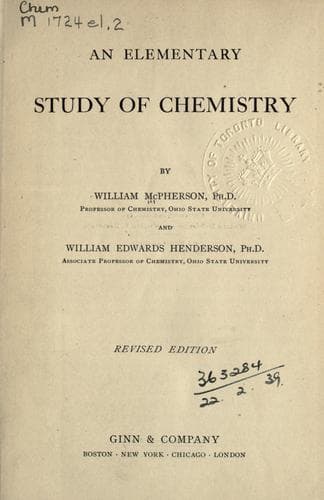
An Elementary Study of ChemistryMcPherson, William
Science
An Elementary Study of Chemistry
McPherson, William
Chemistry
~Uses of carbon.~ The chief use of amorphous carbon is for fuel to furnish
heat and power for all the uses of civilization. An enormous quantity of
carbon in the form of the purer coals, coke, and charcoal is used as a
reducing agent in the manufacture of the various metals, especially in
the metallurgy of iron. Most of the metals are found in nature as
oxides, or in forms which can readily be converted into oxides. When
these oxides are heated with carbon the oxygen is abstracted, leaving
the metal. Retort carbon and coke are used to make electric light
carbons and battery plates, while lampblack is used for indelible inks,
printer's ink, and black varnishes. Bone black and charcoal have the
property of absorbing large volumes of certain gases, as well as smaller
amounts of organic matter; hence they are used in filters to remove
noxious gases and objectionable colors and odors from water. Bone black
is used extensively in the sugar refineries to remove coloring matter
from the impure sugars.
~Chemistry of carbon compounds.~ Carbon is remarkable for the very large
number of compounds which it forms with the other elements, especially
with oxygen and hydrogen. Compounds containing carbon are more numerous
than all others put together, and the chemistry of these substances
presents peculiarities not met with in the study of other substances.
For these reasons the systematic study of carbon compounds, or of
_organic chemistry_ as it is usually called, must be deferred until the
student has gained some knowledge of the chemistry of other elements. An
acquaintance with a few of the most familiar carbon compounds is,
however, essential for the understanding of the general principles of
chemistry.
~Compounds of carbon with hydrogen,--the hydrocarbons.~ Carbon unites with
hydrogen to form a very large number of compounds called _hydrocarbons_.
Petroleum and natural gas are essentially mixtures of a great variety of
these hydrocarbons. Many others are found in living plants, and still
others are produced by the decay of organic matter in the absence of
air. Only two of them, methane and acetylene, will be discussed here.
~Methane~ (_marsh gas_) (CH_{4}). This is one of the most important of
these hydrocarbons, and constitutes about nine tenths of natural gas. As
its name suggests, it is formed in marshes by the decay of vegetable
matter under water, and bubbles of the gas are often seen to rise when
the dead leaves on the bottom of pools are stirred. It also collects in
mines, and, when mixed with air, is called _fire damp_ by the miners
because of its great inflammability, damp being an old name for a gas.
It is formed when organic matter, such as coal or wood, is heated in
closed vessels, and is therefore a principal constituent of coal gas.
Public-domain text, read in full here on John Shaqi.
Reviews
Reviews
No reviews yet
Be the first to share your thoughts on this work.
Elsewhere in the archive
Join the Discussion
Join the discussion
Sign in to leave a comment or review.
Sign InorCreate an account