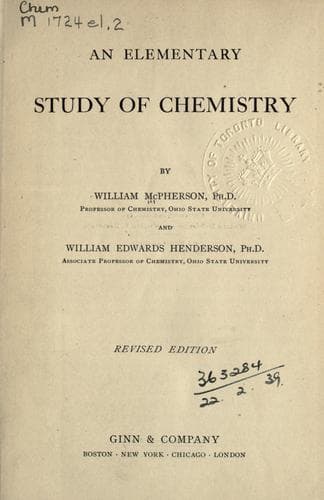
An Elementary Study of ChemistryMcPherson, William
Science
An Elementary Study of Chemistry
McPherson, William
Chemistry
When oxygen combines with zinc the combination must be between definite
numbers of the two kinds of atoms. Experiment shows that these two
elements combine in the ratio of 16 g. of oxygen to 65.4 g. of zinc. If
one atom of oxygen combines with one atom of zinc, then this ratio must
be the ratio between the weights of the two atoms. If one atom of oxygen
combines with two atoms of zinc, then the ratio between the weights of
the two atoms will be 16: 32.7. If two atoms of oxygen combine with one
atom of zinc, the ratio by weight between the two atoms will be 8: 65.4.
It is evident, therefore, that the real atomic weight of an element must
be some multiple or submultiple of the equivalent; in other words, the
equivalent multiplied by 1/2, 1, 2, or 3 will give the atomic weight.
~Combining weights.~ A very interesting relation holds good between the
equivalents of the various elements. We have just seen that the figures
16.03, 65.4, 215.86, and 70.9 are the equivalents respectively of
sulphur, zinc, silver, and chlorine. These same figures represent the
ratios by weight in which these elements combine among themselves. Thus
215.86 g. of silver combine with 70.9 g. of chlorine and with 2 x 16.03
g. of sulphur. 65.4 g. of zinc combine with 70.9 g. of chlorine and 2 x
16.03 g. of sulphur.
By taking the equivalent or some multiple of it a value can be obtained
for each element which will represent its combining value, and for this
reason is called its _combining weight_. It is important to notice that
the fact that a combining weight can be obtained for each element is not
a part of a theory, but is the direct result of experiment.
~Elements with more than one equivalent.~ It will be remembered that
oxygen combines with hydrogen in two ratios. In one case 16 g. of oxygen
combine with 2.016 g. of hydrogen to form water; in the other 16 g. of
oxygen combine with 1.008 g. of hydrogen to form hydrogen dioxide. The
equivalents of hydrogen are therefore 2.016 and 1.008. Barium combines
with oxygen in two proportions: in barium oxide the proportion is 16 g.
of oxygen to 137.4 g. of barium; in barium dioxide the proportion is 16
g. of oxygen to 68.7 g. of barium.
In each case one equivalent is a simple multiple of the other, so the
fact that there may be two equivalents does not add to the uncertainty.
All we knew before was that the true atomic weight is some multiple of
the equivalent.
Public-domain text, read in full here on John Shaqi.
Reviews
Reviews
No reviews yet
Be the first to share your thoughts on this work.
Elsewhere in the archive
Join the Discussion
Join the discussion
Sign in to leave a comment or review.
Sign InorCreate an account