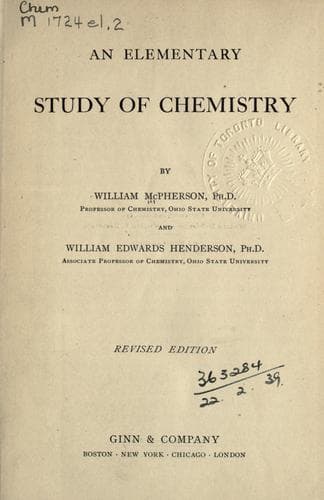
An Elementary Study of ChemistryMcPherson, William
Science
An Elementary Study of Chemistry
McPherson, William
Chemistry
NAME DENSITY COMPOSITION BY PERCENTAGE
Hydrosulphuric acid 1.1791 S = 94.11 H = 5.89
Sulphur dioxide 2.222 S = 50.05 O = 49.95
Sulphur trioxide 2.74 S = 40.05 O = 59.95
Sulphur chloride 4.70 S = 47.48 Cl = 52.52
Sulphuryl chloride 4.64 S = 23.75 Cl = 52.53 O = 23.70
Carbon disulphide 2.68 S = 84.24 C = 15.76
2. Calculate the formulas for compounds of the following compositions:
MOLECULAR
WEIGHT
(1) S = 39.07% O = 58.49% H = 2.44% 81.0
(2) Ca = 29.40 S = 23.56 O = 47.04 136.2
(3) K = 38.67 N = 13.88 O = 47.45 101.2
3. The molecular weight of ammonia is 17.06; of sulphur dioxide is
64.06; of chlorine is 70.9. From the molecular weight calculate the
weight of 1 l. of each of these gases. Compare your results with the
table on the back cover of the book.
4. From the molecular weight of the same gases calculate the density of
each, referred to air as a standard.
5. A mixture of 50 cc. of carbon monoxide and 50 cc. of oxygen was
exploded in a eudiometer, (a) What gases remained in the tube after
the explosion? (b) What was the volume of each?
6. In what proportion must acetylene and oxygen be mixed to produce the
greatest explosion?
7. Solve Problem 18, Chapter XVII, without using molecular weights.
Compare your results.
8. Solve Problem 10, Chapter XVIII, without using molecular weights.
Compare your results.
9. The specific heat of aluminium is 0.214; of lead is 0.031. From these
specific heats calculate the atomic weights of each of the elements.
CHAPTER XX
THE PHOSPHORUS FAMILY
==================================================
| | ATOMIC | | MELTING
| SYMBOL | WEIGHT | DENSITY | POINT
-----------+--------+---------+---------+---------
Phosphorus | P | 31.0 | 1.8 | 43.3 deg.
Arsenic | As | 75.0 | 5.73 | ---
Antimony | Sb | 120.2 | 6.7 | 432 deg.
Bismuth | Bi | 208.5 | 9.8 | 270 deg.
==================================================
~The family.~ The elements constituting this family belong in the same
group with nitrogen and therefore resemble it in a general way. They
exhibit a regular gradation of physical properties, as is shown in the
above table. The same general gradation is also found in their chemical
properties, phosphorus being an acid-forming element, while bismuth is
essentially a metal. The other two elements are intermediate in
properties.
~Compounds.~ In general the elements of the family form compounds having
similar composition, as is shown in the following table:
Public-domain text, read in full here on John Shaqi.
Reviews
Reviews
No reviews yet
Be the first to share your thoughts on this work.
Elsewhere in the archive
Join the Discussion
Join the discussion
Sign in to leave a comment or review.
Sign InorCreate an account